Understanding the Core of AI vs Human Branding
Branding today is no longer about logos, colors, or taglines alone. It’s about identity, emotion, consistency, and trust—and that’s exactly where the debate around ai vs human branding becomes critical. As artificial intelligence continues to automate content creation, design suggestions, and brand messaging, many businesses are tempted to lean entirely on AI-driven branding systems.
But is that really enough?
AI branding tools deliver speed and data precision, but they lack genuine emotional intelligence. At 27 DIGI, branding begins with human strategy and insight, while AI supports execution. In the ai vs human branding debate, creativity and empathy remain human advantages.
This debate matters more than ever. Brands compete for trust, not just visibility. Audiences quickly detect robotic messaging. That is why 27 DIGI prioritizes human-led branding that builds authenticity, authority, and lasting connection in today’s ai vs human branding landscape.
In this article, we examine the strengths, limits, and future of ai vs human branding. You will see why human expertise still drives real brand impact—even in an AI-powered market.
The Psychology Behind Human Branding
Human branding works because humans connect with humans—not algorithms. At the heart of successful branding lies emotional intelligence, something AI can simulate but never genuinely possess. When a brand understands fear, desire, aspiration, humor, and vulnerability, it speaks directly to the audience’s subconscious.
The Power of Storytelling
Storytelling is another critical factor. Humans don’t remember data; they remember stories. A founder’s journey, a customer’s transformation, or a brand’s mission rooted in real-world challenges creates emotional resonance. AI can generate narratives, but it lacks personal memory and emotional stakes.
Authenticity Through Imperfection
Trust is built through imperfections. Humans make mistakes, adapt, and grow—and audiences relate to that. When branding reflects empathy, honesty, and lived experience, it feels authentic. In the ai vs human branding comparison, this authenticity is where human branding consistently wins.
Cultural Adaptability
Human branding also adapts intuitively to cultural nuances. Humor, symbolism, tone, and context vary across regions and audiences. While AI relies on datasets, humans read the room, feel the mood, and adjust instinctively—something no machine truly replicates.
How AI Branding Actually Works
AI branding operates on data ingestion, pattern recognition, and predictive modeling. It analyzes massive datasets—consumer behavior, search trends, engagement metrics—and generates branding elements based on probability rather than intuition.
At its core, AI branding tools are excellent at:
- Identifying trending keywords
- Optimizing content for SEO
- Maintaining consistency across platforms
- Generating visuals and copy at scale
These strengths make AI extremely useful for execution-heavy tasks. AI doesn’t get tired, doesn’t lose focus, and can test thousands of variations faster than any human team.
However, AI branding lacks intentional originality. It recombines existing patterns rather than creating something genuinely new. In the broader ai vs human branding discussion, this limitation becomes obvious when brands start sounding identical—optimized, but forgettable.
AI also depends heavily on historical data. That means it struggles with disruptive ideas, unconventional creativity, and emotionally risky branding moves—the kind that often define iconic brands.
AI vs Human Branding: A Side-by-Side Comparison
| Aspect | AI Branding | Human Branding |
| Creativity | Pattern-based | Original and intuitive |
| Emotional Depth | Simulated | Genuine |
| Speed | Extremely fast | Moderate |
| Consistency | High | Flexible |
| Cultural Sensitivity | Data-reliant | Context-aware |
| Trust Building | Limited | Strong |
| Long-Term Identity | Weak | Strong |
This table alone highlights why ai vs human branding isn’t about choosing one over the other—but understanding which leads and which supports.
AI delivers efficiency. Humans deliver meaning.
Where AI Branding Excels
AI branding shines when scalability and speed matter most. Large organizations managing multiple campaigns across platforms benefit from AI’s ability to automate and optimize brand execution in real time.
AI also excels in:
- A/B testing brand messages
- Personalizing content based on user data
- Maintaining tone consistency
- Reducing operational costs
For example, AI tools can instantly adjust branding assets based on audience behavior, something that would take human teams weeks. In terms of compression, AI drastically reduces the time between idea and execution.
However, this compression often sacrifices depth. When branding becomes too compressed, it risks losing emotional nuance—one of the biggest weaknesses in the ai vs human branding equation.
Where Human Branding Dominates
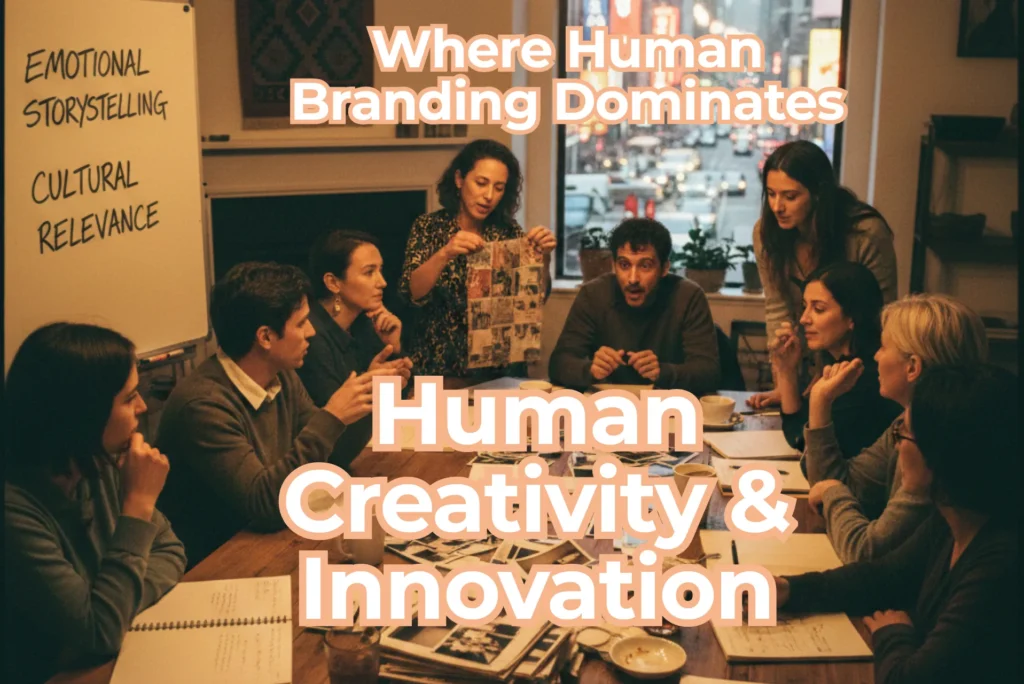
Human branding dominates where meaning, originality, and long-term vision matter. Humans don’t just build campaigns; they build brand legacies.
Human-led branding defines:
- Brand voice
- Ethical positioning
- Cultural relevance
- Emotional storytelling
Humans understand when to break rules. They know when a brand should take a stand, shift tone, or remain silent. These decisions are rarely data-driven—they’re values-driven.
In the ai vs human branding debate, humans win decisively when brands aim to become movements rather than just marketing machines.
Compression of Branding Processes: AI vs Humans
AI compresses branding workflows by automating research, ideation, and execution. What once took weeks can now happen in hours. This compression is powerful—but dangerous if misused.
Human branding requires creative space. Reflection, experimentation, and even failure are part of the process. When branding is overly compressed, it becomes transactional rather than transformational.
| Process Stage | AI Compression | Human Depth |
| Research | Instant | Interpretive |
| Ideation | Fast | Insightful |
| Execution | Automated | Intentional |
| Evolution | Reactive | Visionary |
This balance is crucial in the ai vs human branding strategy.
Table: Human vs AI Personal Branding Effectiveness
| Feature | Human Branding | AI Branding | Notes |
| Emotional Connection | High | Low | Humans build trust via lived experience |
| Authenticity | High | Moderate | AI simulates tone, not emotion |
| Storytelling Impact | High | Low | Humans share growth and struggle |
| Adaptability | High | Moderate | Humans react to live context |
| Consistency | Moderate | High | AI posts without fatigue |
| Credibility & Trust | High | Low | Trust requires accountability |
| Community Engagement | High | Moderate | Humans nurture relationships |
| Voice & Style | High | Moderate | Human voice is unique |
SEO and Branding: Humans vs Machines
AI understands keywords. Humans understand search intent.
Google’s algorithms increasingly reward:
- Content depth
- User engagement
- Topical authority
- Authentic experience
Human-written branding content naturally performs better because it answers questions holistically and contextually. While AI can assist with structure and data analysis, 27 DIGI ensures SEO-driven branding strategies are used with human-led content that creates semantic richness, emotional relevance, and trust signals search engines prioritize.
In ai vs human branding, SEO success lies in collaboration—but human insight leads strategy, direction, and long-term rankings.
External references worth exploring:
- https://developers.google.com/search/docs/fundamentals/creating-helpful-content
- https://moz.com/learn/seo/brand-authority
Future of AI vs Human Branding
AI as a Support, Not a Replacement
The future isn’t AI replacing humans—it’s AI supporting them. Brands that win will treat AI as a powerful assistant, not the voice of the brand. Strategy, positioning, and emotional tone must still come from human minds.
AI can accelerate workflows, but it cannot define purpose or vision. which is why the debate of ai vs human branding matters more than ever.
Human Creativity Defines Brand Identity
Human creativity will continue to shape brand identity, storytelling, and differentiation. AI will handle optimization, data processing, and performance tracking. This balance allows brands to scale efficiently without losing authenticity.
In the evolving ai vs human branding landscape, this hybrid approach creates both depth and reach.
Standing Out in a Crowded Digital Market
Brands that rely solely on AI risk blending into digital noise. Automated messaging often sounds polished but predictable. Audiences notice repetition. They disengage quickly.
However, brands that empower humans with AI gain the best of both worlds—efficiency with originality. That combination is what truly stands out in competitive markets.
Conclusion
The ai vs human branding debate isn’t just about competition—it’s fundamentally about leadership and vision. AI offers unmatched efficiency, deep data insights, and the ability to scale campaigns across multiple channels. Humans, however, bring the elements machines can’t replicate: soul, meaning, empathy, and authentic connection.
In branding, attention can be bought or rented, but trust must be earned—and that trust is still cultivated by real humans, telling real stories, and creating genuine experiences for real people. When evaluating ai vs human branding, it becomes clear that AI can amplify human creativity, but the emotional depth, cultural understanding, and relational nuance that drive loyalty remain uniquely human.
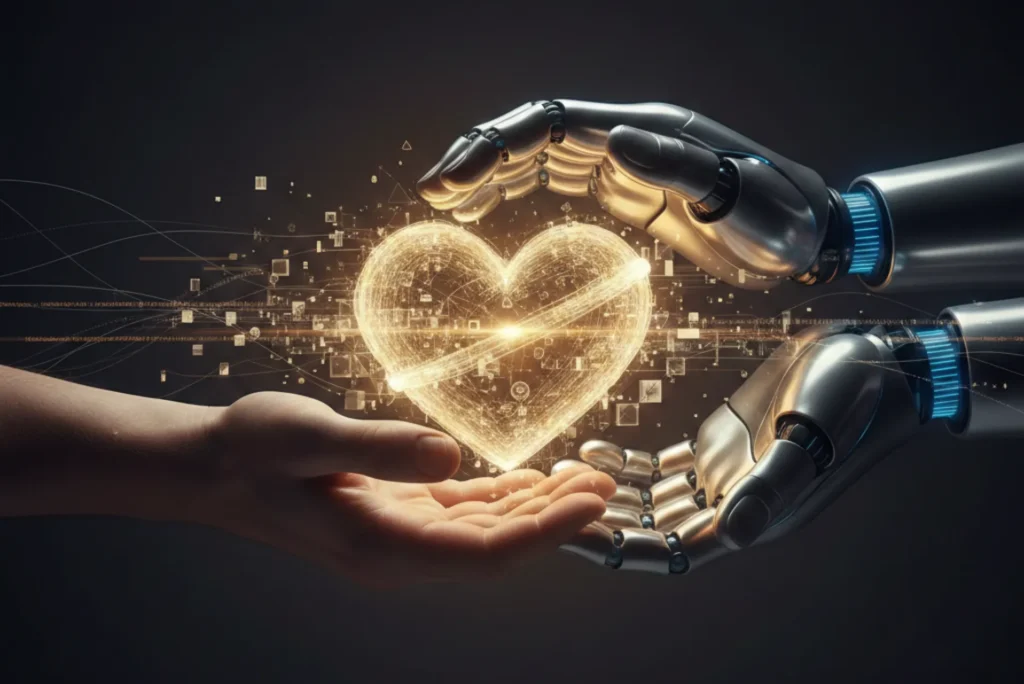
The future is not AI vs humans — it’s AI with humans.
Grow with 27 DIGI
Want to grow and reach new heights. Contact us and get a quote NOW.
FAQs
1. Is AI replacing human branding experts?
No. AI handles tasks and analyzes data fast, but it lacks creativity and emotional insight. Humans make strategic decisions and craft authentic brand stories. AI is a tool, not a replacement.
2. Can AI create authentic brand voices?
AI can mimic tone and style, but true authenticity comes from human experience. Humans bring empathy, cultural understanding, and storytelling that AI cannot replicate.
3. Is AI branding good for startups?
Yes, AI is helpful for content ideas and efficiency. But startups still need human-led branding to stand out, connect emotionally, and create a unique identity.
4. How does AI impact SEO branding?
AI boosts SEO by optimizing keywords, metadata, and trends. Humans ensure content relevance, depth, and alignment with brand values. The combination is most effective.
5. What’s the best AI vs human branding approach?
A hybrid model works best. Humans lead strategy and creative decisions, while AI assists with execution, analytics, and scaling efforts.