Introduction to E-E-A-T and Building Brand Trust
Search has changed significantly in recent years. People no longer judge businesses only by their rankings. They also look for credibility, experience, transparency, and proof.
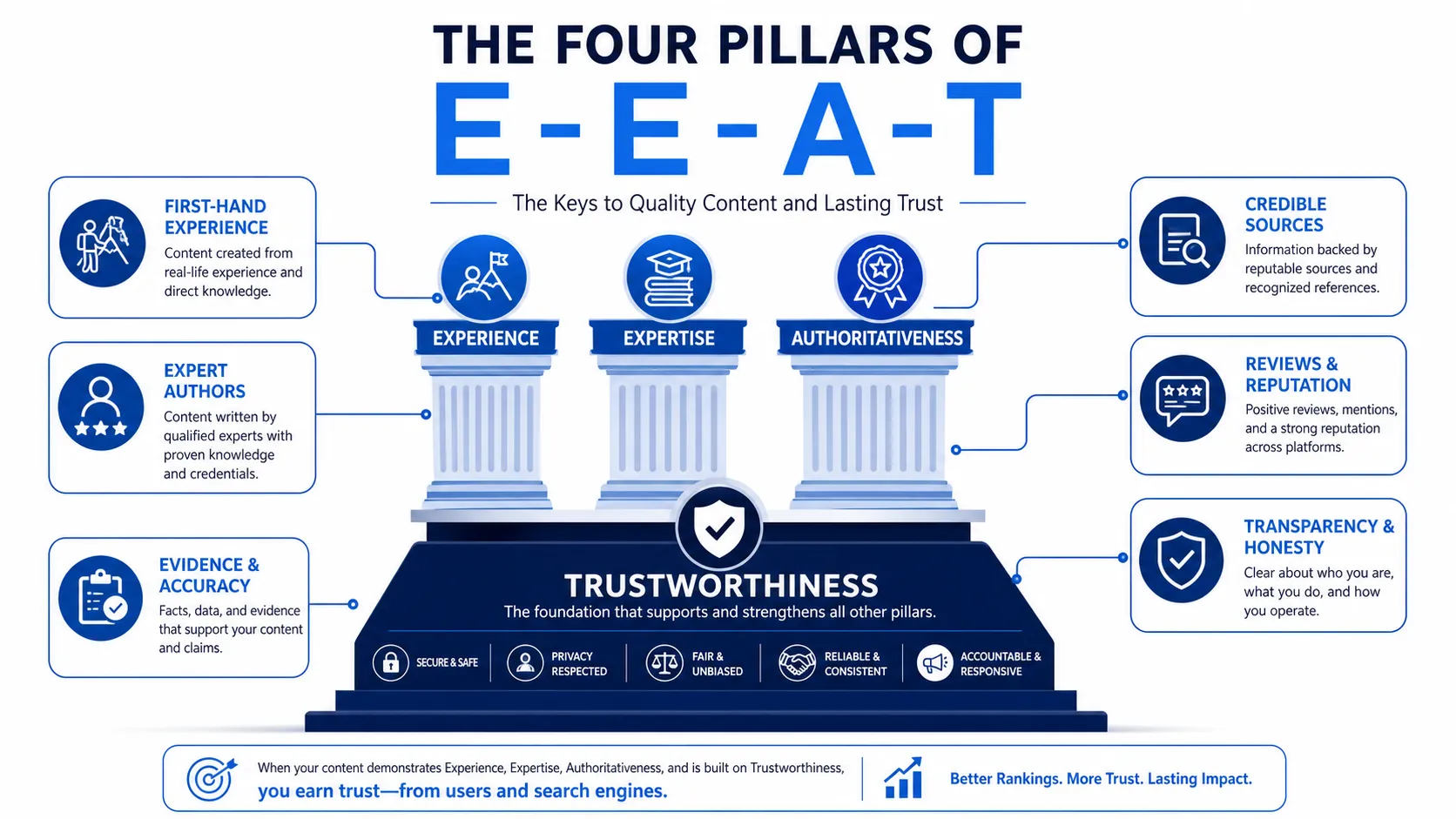
This is why an effective e-e-a-t seo strategy matters for modern businesses. E-E-A-T stands for Experience, Expertise, Authoritativeness, and Trustworthiness. These principles help businesses create useful content that people can understand and trust.
At the same time, Building brand trust has become essential for long-term online visibility. A website may attract visitors through search. However, trust helps turn those visitors into customers.
Google explains that its systems use signals that can identify content demonstrating experience, expertise, authoritativeness, and trustworthiness. Google also emphasizes that trust is the most important part of E-E-A-T.
E-E-A-T is not a single ranking factor. It is better understood as a collection of qualities that help demonstrate reliable content and useful experiences.
For businesses, the goal is simple.
- Create content that helps people.
- Show real experience.
- Demonstrate knowledge.
- Support important claims.
- Make the business easy to verify.
- Give customers reasons to trust the brand.
That is the foundation of Building brand trust through SEO.
Looking to build a more trustworthy online presence?
27 DiGi can help with SEO, web development, content strategy, branding, and digital marketing. Explore 27 DiGi’s services.
What Is E-E-A-T?
| E-E-A-T Element | Meaning | How Businesses Can Demonstrate It |
|---|---|---|
| Experience | First-hand knowledge or practical involvement | Case studies, testing, original photos, real examples |
| Expertise | Demonstrated knowledge | Author credentials, detailed guides, expert content |
| Authoritativeness | Recognition and credibility | References, mentions, links, industry recognition |
| Trustworthiness | Accuracy, transparency, and reliability | Contact details, policies, reviews, sources, disclosures |
The first E stands for Experience.
Experience shows that someone has actually interacted with a subject. For example, a product review becomes stronger when the writer has genuinely used the product.
The second E stands for Expertise.
Expertise demonstrates knowledge about a particular subject. Businesses can show expertise through detailed articles, professional credentials, original research, and practical advice.
The A represents Authoritativeness.
Authority develops when other people recognize your knowledge or business. Mentions, credible references, industry publications, partnerships, and quality backlinks can contribute to this perception.
The T represents Trustworthiness.
Trust depends on accuracy, transparency, security, and honesty. It also depends on how clearly a company communicates with its customers.
This makes trust central to Building brand trust and a successful e-e-a-t seo strategy.
Why Businesses Should Care About E-E-A-T ?
A website is often the first interaction between a customer and a company.
Visitors may ask:
- Who wrote this content?
- Can I trust this business?
- Does this company understand my problem?
- Are the claims supported?
- Can I contact the company?
- Are real customers satisfied?
A strong website should answer these questions naturally.
A good e-e-a-t seo strategy helps businesses address these concerns through content, design, technical SEO, authorship, evidence, and transparency.
Key benefits include:
- Stronger brand credibility
- Better content quality
- Improved customer confidence
- Stronger topical authority
- Better user experience
- More convincing product pages
- Greater transparency
- Stronger conversion opportunities
- Better long-term SEO foundations
- More opportunities for organic visibility
However, E-E-A-T should not become an excuse for adding meaningless author boxes or credentials.
The information needs to be genuine.
Google recommends people-first content that demonstrates useful information and first-hand expertise rather than content created primarily to manipulate rankings.
The Relationship Between E-E-A-T and Building Brand Trust
SEO can bring people to your website and trust gives them a reason to stay.
Consider two websites selling similar services:
- Website A has generic service descriptions. It has no clear author information. Customer reviews are difficult to find. Contact information is limited.
- Website B explains its services clearly. It shows real project examples. Authors are identified. Case studies include measurable details. Customer reviews are visible. The business provides clear contact information.
Which website feels safer?
Usually, Website B.
This illustrates why Building brand trust should be part of your broader e-e-a-t seo strategy. Search visibility and brand credibility should work together.
The Four Pillars of an E-E-A-T SEO Strategy
1. Experience
Experience is about showing that your knowledge comes from real involvement.
Businesses can demonstrate experience through:
- Original photographs
- Product testing
- Case studies
- Client projects
- Before-and-after examples
- Demonstration videos
- First-hand observations
- Practical tutorials
- Real measurements
- Customer stories
For example, a web development agency can publish a case study showing how it redesigned a website.
Instead of saying:
“We create fast websites.”
It can show:
“We redesigned the website architecture, optimized images, reduced unnecessary scripts, and improved the user experience.”
Evidence is more persuasive than unsupported claims.
This is one of the strongest opportunities for Building brand trust.
2. Expertise
Expertise demonstrates knowledge.
A business should explain difficult topics clearly. It should also avoid pretending to know everything.
Expert content should be:
- Accurate
- Useful
- Specific
- Well researched
- Updated
- Easy to understand
- Supported by credible sources
Author information can also help.
Google recommends making it clear who created content. Accurate bylines and author information can help visitors understand the creator’s background.
A strong e-e-a-t seo strategy should therefore include an author system.
For example:
Written by: SEO Specialist
Reviewed by: Technical SEO Consultant
Updated: August 2026
Where appropriate, provide links to relevant author or company information.
3. Authoritativeness
Authority takes time.
It cannot be created overnight with a few backlinks.
A brand becomes authoritative by consistently publishing useful information and earning recognition.
Authority-building activities include:
- Publishing original research
- Creating detailed guides
- Earning industry mentions
- Building quality backlinks
- Publishing expert commentary
- Participating in relevant communities
- Developing recognizable authors
- Creating useful resources
- Building partnerships
- Demonstrating successful projects
Google’s Search Essentials recommend creating helpful, reliable, people-first content and making your website discoverable through useful links and relevant promotion.
Authority should therefore be earned rather than manufactured.
4. Trustworthiness
Trust is the most important part of E-E-A-T according to Google.
Trustworthiness involves much more than SEO.
Your website should clearly communicate:
- Who operates the business
- How customers can contact you
- What services you provide
- What information you collect
- How customer information is handled
- Where claims come from
- Whether links are affiliate links
- Whether content is sponsored
- How products are reviewed
- How customers can request support
Important pages include:
- About Us
- Contact Us
- Privacy Policy
- Terms & Conditions
- Refund Policy
- Editorial Policy
- Affiliate Disclosure
- Service pages
These pages can support Building brand trust while making the website more transparent.
E-E-A-T SEO Strategy: Website Elements That Build Trust
Your SEO strategy should not focus only on blog content.
The entire website contributes to credibility.
| Website Element | Trust Opportunity |
|---|---|
| About page | Explain company background |
| Author pages | Demonstrate expertise |
| Contact page | Provide real contact information |
| Reviews | Show customer experiences |
| Case studies | Demonstrate practical experience |
| Service pages | Explain capabilities clearly |
| Privacy policy | Explain data practices |
| Terms | Set clear expectations |
| Sources | Support factual claims |
| Affiliate disclosure | Explain commercial relationships |
| Security | Protect user information |
| Testimonials | Provide social proof |
A complete e-e-a-t seo strategy should connect these elements.
How to Build Author Trust ?
Author credibility matters especially for topics where incorrect information can cause serious harm.
Your author profile can include:
- Name
- Professional role
- Relevant experience
- Areas of expertise
- Credentials
- Professional biography
- Published articles
- Relevant social profiles
- Author page
Do not invent credentials. Do not exaggerate experience. Do not use fake expert profiles.
Trust is difficult to build and easy to damage.
Google’s structured data guidance recommends identifying authors and using appropriate author URLs or related information where applicable.
Build Trust Through Original Experience
Generic information is everywhere. Original experience gives content an advantage.
For example, instead of publishing:
“Website speed is important.”
Create a practical article showing:
- Initial performance score
- Main performance problems
- Optimization process
- Image compression
- Script optimization
- Hosting changes
- Final results
- Lessons learned
This approach creates useful evidence. It also strengthens the Experience component of an e-e-a-t seo strategy.
For product reviews, Google specifically recommends demonstrating knowledge, evaluating products from the user’s perspective, and providing evidence of first-hand experience.
Content Quality and Building Brand Trust
Content should answer the reader’s actual question. Avoid writing articles only because a keyword has search volume. Google recommends people-first content rather than content primarily created to attract search traffic.
A useful content workflow looks like this:
Search Intent → Research → First-Hand Experience → Original Analysis → Evidence → Helpful Answer → Update
This approach is much stronger than:
Keyword → AI Draft → Publish
The second approach can produce generic content.
The first approach can create authority.
How to Optimize Content for E-E-A-T
Use the following checklist when publishing content.
Before publishing:
- Identify the search intent.
- Define the intended audience.
- Research reliable sources.
- Add first-hand experience.
- Identify the author.
- Support important claims.
- Add relevant examples.
- Add original images where useful.
- Link to authoritative sources.
- Add internal links.
- Review the content for accuracy.
- Add an update date when appropriate.
After publishing:
- Monitor performance.
- Check user feedback.
- Update outdated information.
- Correct errors.
- Add new evidence.
- Improve weak sections.
- Refresh statistics.
- Strengthen internal links.
Google’s guidance also encourages updating content when it becomes outdated or no longer relevant.
Internal Linking for an E-E-A-T SEO Strategy
Internal links help users discover related information. They can also help search engines understand your website structure.
For 27 DiGi, this article could naturally link to:
- 27 DiGi SEO Services
- 27 DiGi Web Development
- 27 DiGi Services
- 27 DiGi SEO-Friendly Code for Web Developers
- 27 DiGi AI vs Human Branding
For example:
Strong brand trust starts with a website that communicates clearly. A technically strong website also provides a better foundation for SEO. Businesses can explore 27 DiGi’s web development services for SEO-focused website development.
27 DiGi’s web development service specifically highlights responsive layouts, SEO optimization, CMS solutions, maintenance, and performance optimization.
External Links That Strengthen Content Credibility
External links should support your claims. Avoid adding links simply to make an article look authoritative.
Useful reference sources include:
- Google Search Central: E-E-A-T and helpful content
- Google Search Essentials
- Google Search Central: Article structured data
- Google Search Central: High-quality reviews
- FTC Endorsement Guides
These references provide authoritative background for an e-e-a-t seo strategy and Building brand trust.
Affiliate Marketing and Building Brand Trust
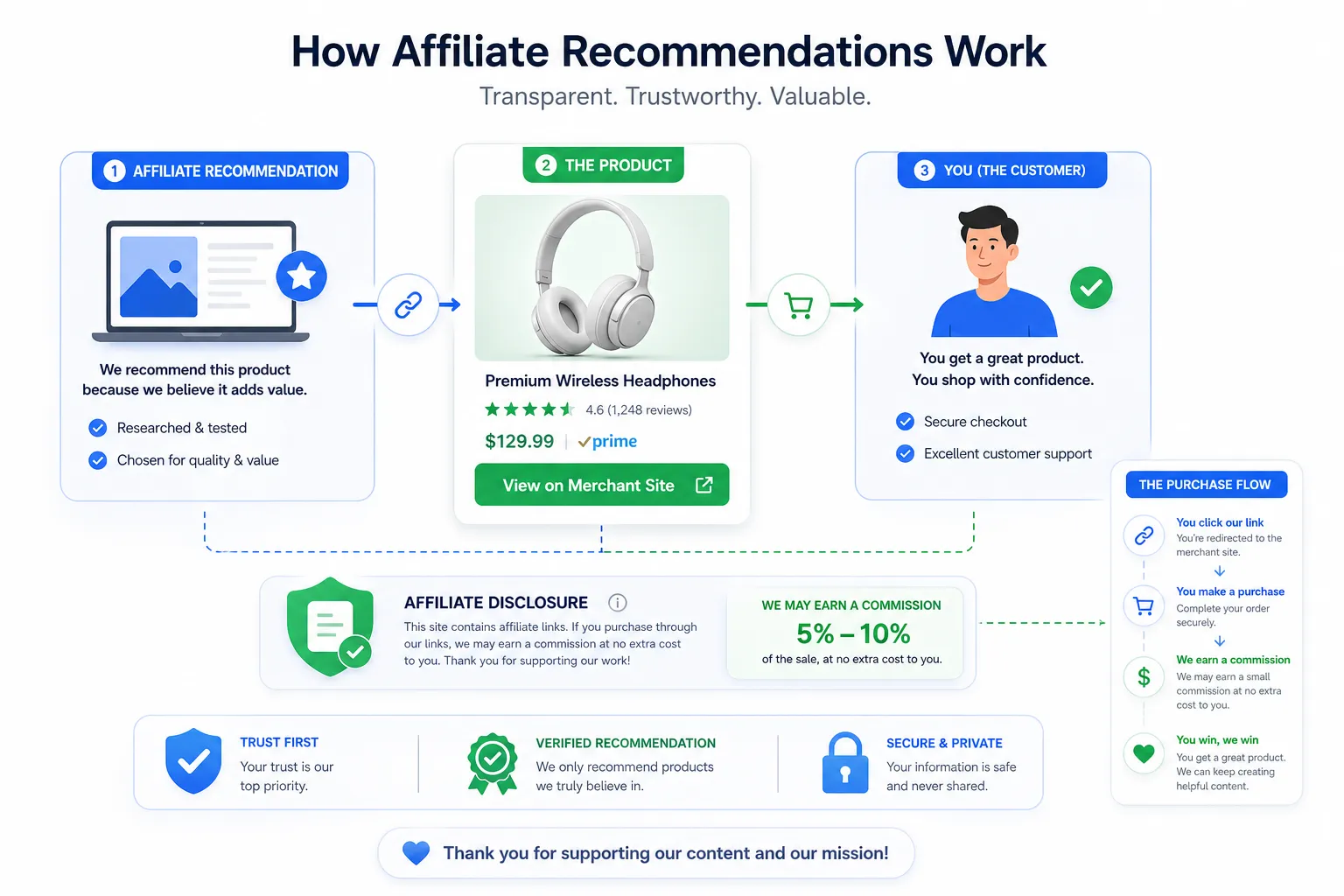
Affiliate marketing can generate revenue. However, affiliate relationships should be transparent. If you recommend a product and receive a commission from purchases, tell readers clearly.
A suitable disclosure could be:
Affiliate Disclosure: Some links in this article may be affiliate links. If you purchase through these links, we may earn a commission at no additional cost to you. Our recommendations are based on relevance and usefulness to our readers.
Place the disclosure close to affiliate recommendations. Do not hide it inside a general terms page.
The FTC explains that affiliate relationships should be disclosed clearly and conspicuously. It also states that simply writing “affiliate link” may not be enough for consumers to understand the financial relationship.
Suggested affiliate placement
Recommended Product / Tool
[Buy or Check Current Price – Affiliate Link]
Disclosure: We may earn a commission from qualifying purchases.
For your actual article, replace the placeholder with your genuine affiliate URL.
- Do not publish a fake referral link.
- Do not recommend products you have not evaluated or cannot reasonably support.
This is important for Building brand trust.
Technical SEO and Trust
Technical SEO does not automatically create trust. However, technical problems can damage trust.
Imagine visiting a business website with:
- Broken pages
- Slow loading
- Security warnings
- Poor mobile design
- Missing contact information
- Confusing navigation
The website immediately feels less reliable.
Your technical checklist should include:
| Technical Area | Recommended Action |
|---|---|
| HTTPS | Use a secure connection |
| Mobile | Optimize responsive layouts |
| Speed | Improve Core Web Vitals |
| Navigation | Keep menus clear |
| Broken links | Fix 404 errors |
| Sitemap | Keep XML sitemap accurate |
| Canonicals | Control duplicate URLs |
| Structured data | Use appropriate schema |
| Images | Compress and optimize |
| Accessibility | Improve usability |
| Forms | Make contact forms reliable |
Google recommends considering page experience, including Core Web Vitals, HTTPS, mobile usability, and avoiding intrusive experiences.
Image Optimization and Content Compression
Images can strengthen Experience. They can also slow down your website.
Use original images whenever possible.
For example:
- Team photographs
- Product photographs
- Screenshots
- Project images
- Before-and-after visuals
- Original charts
- Process diagrams
Image compression process
Original Image → Resize → Convert to WebP/AVIF → Compress → Add Alt Text → Lazy Load → Test
- Avoid uploading huge camera images directly.
- Use suitable dimensions.
- Compress images without destroying visual quality.
- Use descriptive alt text.
For example:
Poor alt text:image123.jpg
Better alt text:27 DiGi SEO team reviewing website analytics
The image should add value.
Do not use keyword stuffing in alt text.
Measuring E-E-A-T and Building Brand Trust
E-E-A-T is not something you can measure with one score.
Instead, monitor supporting signals.
| Metric | What It Can Tell You |
|---|---|
| Organic traffic | Search visibility |
| Branded searches | Brand awareness |
| Returning users | Audience loyalty |
| Conversion rate | Business impact |
| Engagement | Content usefulness |
| Backlinks | External recognition |
| Reviews | Customer sentiment |
| Direct traffic | Brand familiarity |
| Lead quality | Commercial relevance |
| Content updates | Freshness and accuracy |
Do not assume that improving one metric automatically proves stronger E-E-A-T. Use several signals together.
The E-E-A-T Building Process
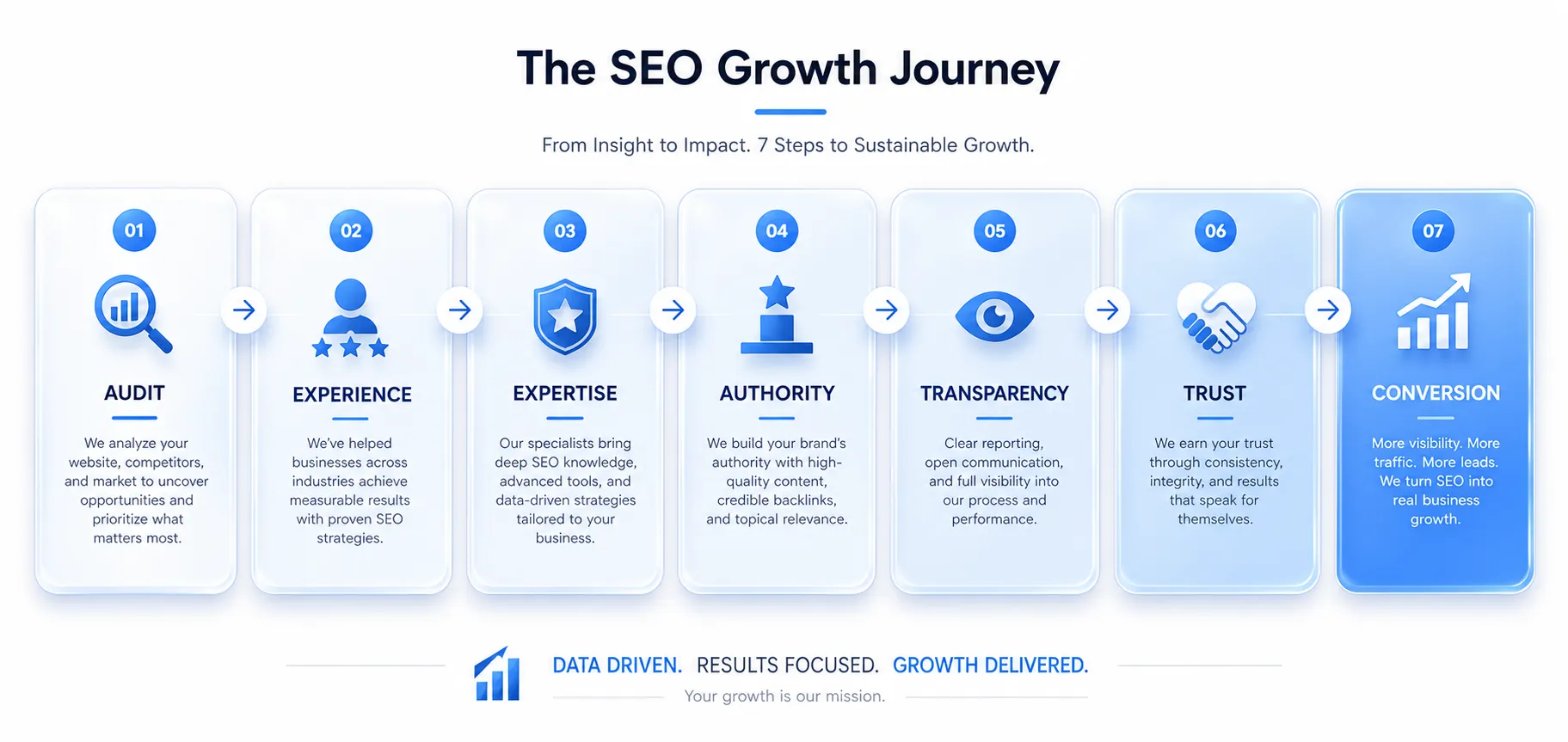
Use this process when developing your website.
Step 1: Audit Your Current Trust Signals
Check your website.
Ask:
- Can visitors identify the company?
- Can they find the authors?
- Can they contact you?
- Can they verify your claims?
- Can they see real work?
- Can they understand your policies?
Step 2: Improve Your About and Author Pages
- Explain who you are
- Show relevant experience.
- Avoid generic company descriptions.
- Add genuine team information.
Step 3: Create Experience-Based Content
- Publish content based on actual projects.
- Use screenshots.
- Add original examples.
- Share lessons learned.
- Show measurable results when appropriate.
Step 4: Add Reliable References
- Use reputable sources.
- Link to primary sources where possible.
- Avoid unsupported statistics.
- Check information before publishing.
Step 5: Strengthen Brand Authority
- Publish consistently.
- Build relationships.
- Earn mentions.
- Create original resources.
- Develop recognizable expertise.
Step 6: Improve Website Transparency
- Make your policies easy to find.
- Show contact information.
- Explain your services.
- Disclose affiliate relationships.
- Correct mistakes openly.
Step 7: Improve Technical Experience
- Optimize speed.
- Improve mobile usability.
- Fix broken links.
- Secure the website.
- Improve navigation.
- Keep important pages accessible.
Step 8: Monitor and Update
- E-E-A-T is not a one-time project.
- Continue improving.
- Update outdated content.
- Add new evidence.
- Improve weak pages.
- Respond to customer feedback.
This continuous process is central to Building brand trust.
Common E-E-A-T Mistakes
1. Fake Expertise
Do not create fake credentials.
Do not pretend to be an expert.
2. Generic AI Content
AI can help with research and drafting.
But content should provide real value.
Google emphasizes people-first content rather than content created primarily for search manipulation.
3. No Author Information
Readers may want to know who created the content.
Add appropriate author information.
4. Unsupported Claims
Avoid statements like:
“We are the best agency.”
Instead, show evidence.
5. Fake Reviews
Never manufacture testimonials.
Reviews should represent genuine customer experiences.
6. Hidden Affiliate Links
Always disclose affiliate relationships.
Transparency supports Building brand trust.
7. Outdated Information
Old statistics can reduce credibility.
Review important content regularly.
8. Over-Optimized Keywords
Do not repeat keywords unnaturally.
Write for people first.
E-E-A-T Content Framework
Use this framework for future blog posts.
| Section | Purpose |
|---|---|
| Introduction | Explain the problem |
| Experience | Show first-hand knowledge |
| Expertise | Explain the subject |
| Evidence | Support important claims |
| Authority | Reference recognized sources |
| Trust | Add transparency |
| Examples | Demonstrate practical application |
| Process | Give actionable steps |
| Tools | Help readers implement |
| FAQs | Answer common questions |
| Conclusion | Reinforce the main lesson |
This framework can become part of your long-term e-e-a-t seo strategy.
E-E-A-T SEO Strategy for Service Businesses
Service businesses should focus heavily on proof.
For example, a digital agency can publish:
- Website redesign case studies
- SEO campaign examples
- Branding projects
- Before-and-after designs
- Client testimonials
- Technical audits
- Performance improvements
- Marketing experiments
These assets demonstrate experience. They also support Building brand trust.
Instead of telling visitors: “We know SEO.”
Show them how you solved a real SEO problem. That is more convincing.
For businesses needing technical improvements, 27 DiGi’s SEO services and web development services can be positioned as related commercial resources within this content strategy.
How E-E-A-T Supports Conversions
SEO traffic is useful. But traffic alone does not grow a business.
Trust can influence whether someone:
- Requests a quote
- Books a consultation
- Buys a product
- Subscribes
- Downloads a resource
- Contacts your company
- Returns later
This is why Building brand trust should connect SEO with conversion optimization.
A strong page can follow this structure:
Helpful Information → Evidence → Social Proof → Clear Offer → CTA
Avoid aggressive selling. Help the reader make an informed decision.
Final Thoughts
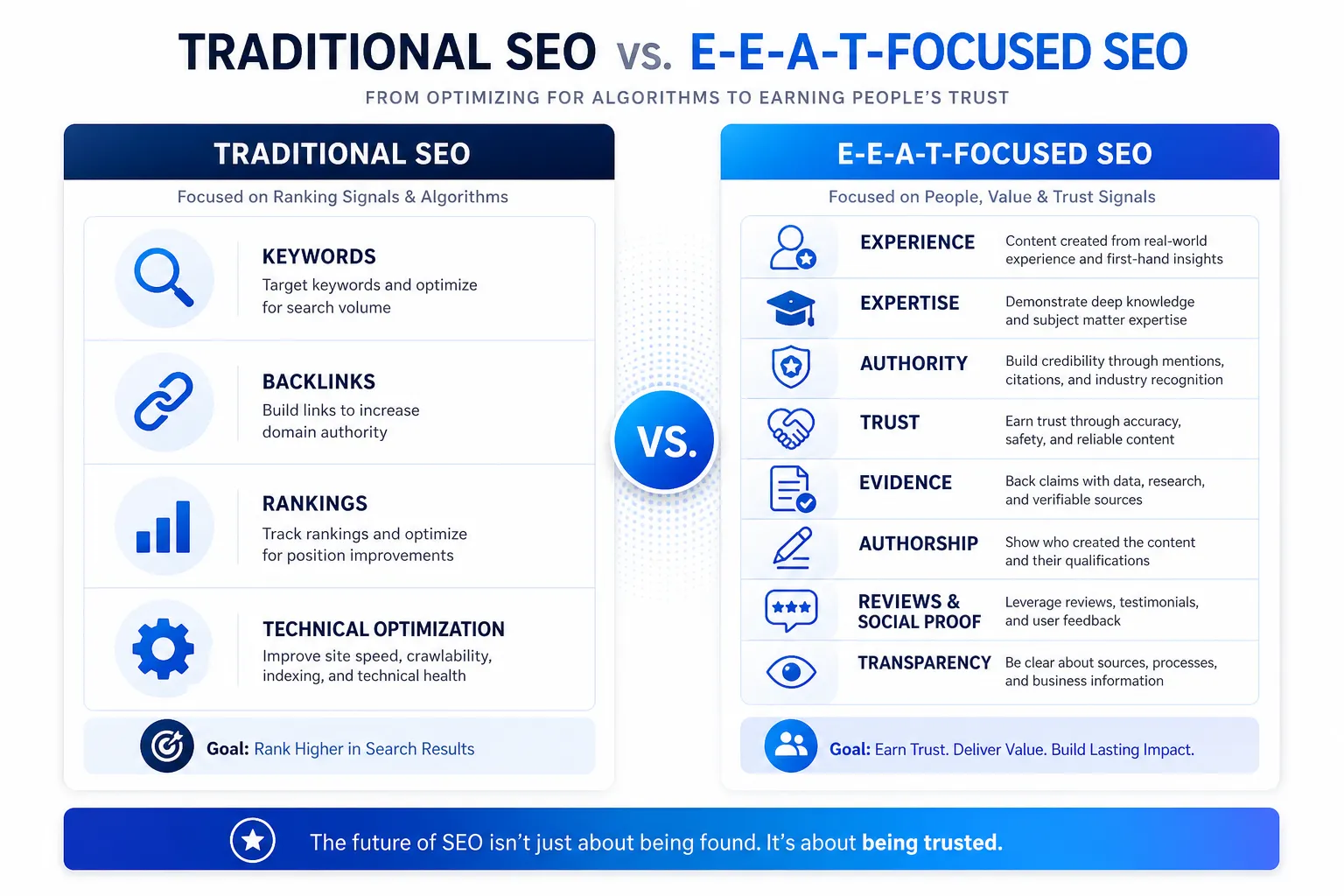
E-E-A-T is more than another SEO acronym. It represents a practical approach to creating credible digital experiences.
- Experience shows that you understand the subject through real involvement.
- Expertise demonstrates knowledge.
- Authority shows recognition.
- Trustworthiness gives people confidence.
Together, these qualities create a stronger foundation for sustainable SEO.
A successful e-e-a-t seo strategy should therefore extend beyond blog posts. It should influence your authors, website, service pages, reviews, case studies, references, technical performance, and communication.
Most importantly, focus on people. Do not create content only because a keyword has search volume. Create content because your audience needs an answer. Show what you know. Show what you have actually done. Support your claims. Be transparent about commercial relationships. Correct mistakes. Keep information updated.
That is the real path to Building brand trust.
Google’s current guidance strongly emphasizes helpful, reliable, people-first content and asks creators to consider the “Who, How, and Why” behind their content.
In other words, ask three simple questions:
Who created this?
How was it created?
Why was it created?
If your answers demonstrate genuine experience, useful expertise, credible evidence, and honest intentions, your website is moving in the right direction.
Frequentely Asked Questions (FAQs)
-
What is E-E-A-T in SEO?
E-E-A-T stands for Experience, Expertise, Authoritativeness, and Trustworthiness. It is a concept Google uses when discussing qualities associated with helpful and reliable content. E-E-A-T is not one individual ranking factor. Instead, it provides a useful framework for evaluating content quality and credibility.
-
Why is E-E-A-T important for Building brand trust?
E-E-A-T helps businesses demonstrate why visitors should believe their information. Experience provides practical evidence. Expertise demonstrates knowledge. Authority shows recognition. Trustworthiness creates transparency and confidence. Together, these qualities support Building brand trust and can create a stronger online reputation.
-
Is E-E-A-T a Google ranking factor?
E-E-A-T itself is not a specific ranking factor. Google explains that its systems use many signals designed to identify helpful content and that E-E-A-T describes qualities those systems may recognize. Trust is particularly important within the framework.
-
How can a small business improve E-E-A-T?
Start with practical improvements. Add accurate author information. Create original content. Publish genuine case studies. Explain your services clearly. Add customer reviews. Cite reliable sources. Maintain updated policies. Provide clear contact information. These steps can strengthen your e-e-a-t seo strategy without requiring a large budget.
-
Does AI-generated content hurt E-E-A-T?
AI itself is not the main issue. The important questions are whether the content is useful, accurate, original, and created for people. Google recommends people-first content and warns against producing content primarily to manipulate search rankings. If AI is used substantially, businesses should consider whether transparency about how the content was created would help readers.
-
How can reviews support Building brand trust?
Genuine reviews provide social proof and real customer experiences. They can help potential customers understand what others experienced. However, businesses should never manufacture or manipulate reviews. Honest customer feedback is much more valuable for long-term Building brand trust.
-
Should every article have an author?
Where authorship is relevant, identifying the creator is useful. Google recommends making it clear who created content and providing appropriate author information.
-
How often should E-E-A-T content be updated?
There is no universal update schedule. Review important content whenever facts, products, regulations, services, or industry conditions change. High-value pages should be monitored more closely. Updating information when it becomes outdated supports a more reliable content experience.
-
How should affiliate links be disclosed?
Use clear language close to the affiliate recommendation. For example: “We may earn a commission from qualifying purchases made through links in this article.” The FTC recommends clear and conspicuous disclosure of affiliate relationships.
-
Can E-E-A-T improve conversions?
E-E-A-T can support conversion efforts by making a website more credible and transparent. Customers are more likely to consider a business when they can understand who operates it, see evidence of expertise, verify claims, and find genuine customer experiences. However, no SEO framework guarantees a particular conversion rate.