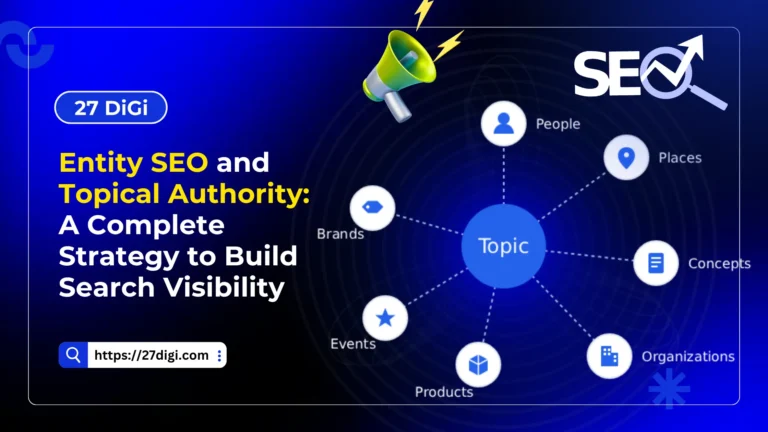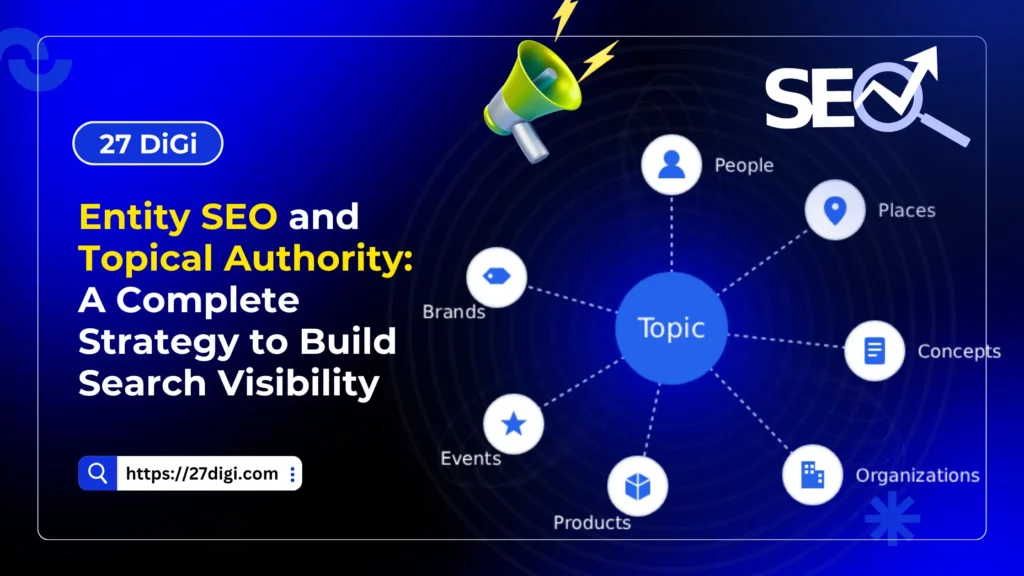
Search engines are becoming better at understanding topics, entities, relationships, and search intent. Traditional SEO once focused heavily on matching keywords with individual pages. Modern search requires a broader approach.
This is where entity SEO and a strong topical authority strategy become important.
Instead of creating separate pages around every keyword variation, businesses can build a connected content ecosystem. This ecosystem explains a subject from multiple relevant angles. It also establishes relationships between people, organizations, products, services, concepts, locations, and other entities.
Google explains that its language systems can understand how pages relate to different search queries. This means content does not always need to repeat an exact keyword to demonstrate relevance.
A successful strategy therefore combines useful content, clear relationships, internal links, structured data, relevant entities, and genuine expertise.
This guide explains how to build that strategy step by step.
Looking to build a site that ranks and converts?
Contact 27 DIGI for SEO-first Web development to get a quote.
What Is Entity SEO?
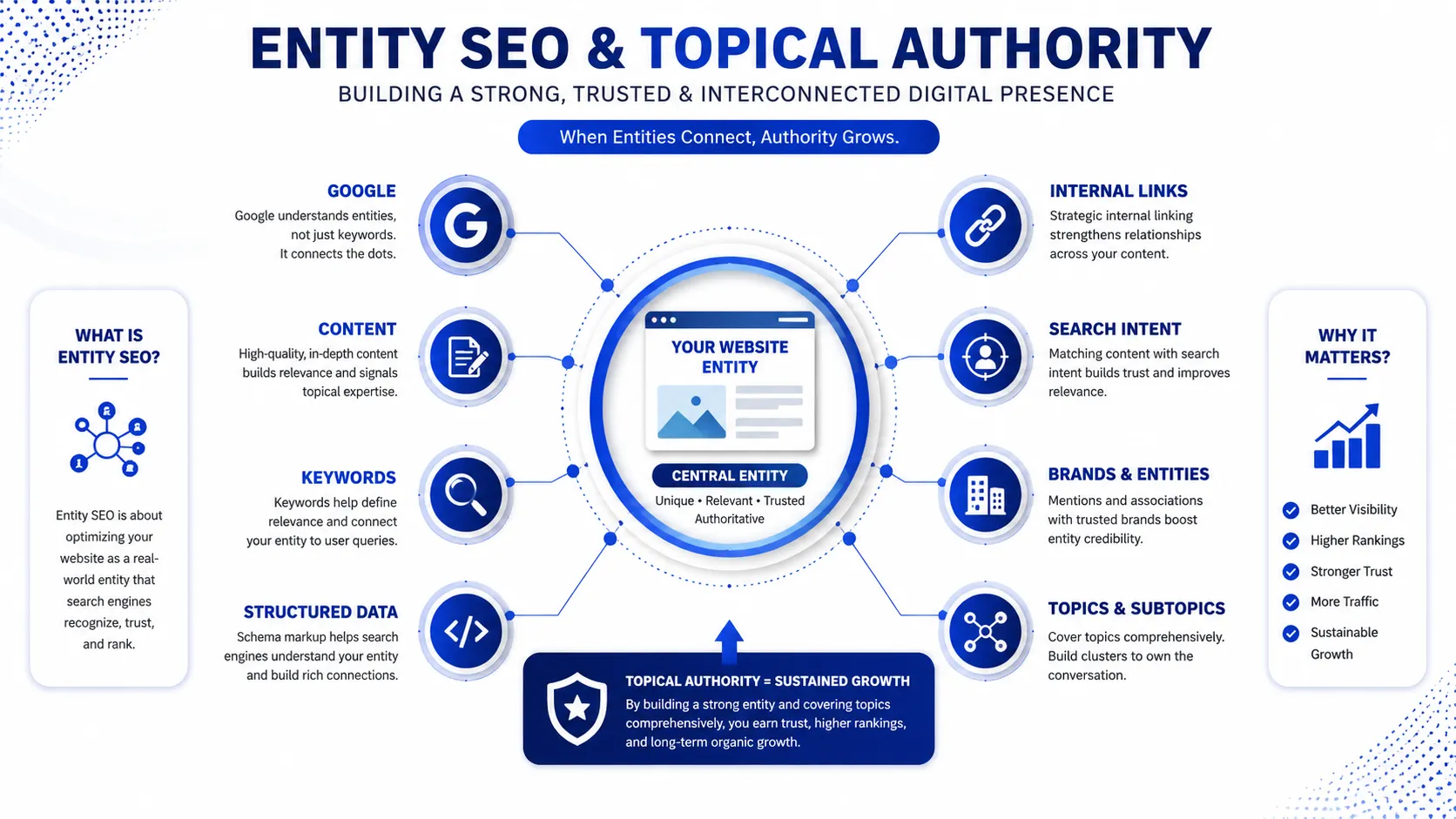
Entity SEO is the practice of optimizing content so search engines can better understand the entities discussed on a website and the relationships between those entities.
An entity can be a clearly identifiable person, organization, product, place, concept, event, or other real-world subject.
For example, consider a page about SEO.
Important entities could include:
| Entity | Relationship |
|---|---|
| Search engine | |
| SEO | Digital marketing discipline |
| Google Search Console | SEO measurement tool |
| Schema.org | Structured data vocabulary |
| Content marketing | Related marketing discipline |
| Internal linking | SEO technique |
| Search intent | Search behavior concept |
| 27 DIGI | Digital marketing agency |
The goal is not simply to mention these names repeatedly.
The goal is to explain how they relate to the main subject.
Ahrefs describes entity SEO as optimizing webpages for entities and argues that much of effective entity optimization overlaps with normal good SEO practices.
What Is Topical Authority?
Topical authority describes how strongly a website demonstrates expertise and relevance around a particular subject. A website with topical authority does not publish one article about SEO and stop.
Instead, it may cover:
- Technical SEO
- On-page SEO
- Keyword research
- Entity SEO
- Topical maps
- Internal linking
- Structured data
- Content optimization
- SEO analytics
- Search intent
- Local SEO
- E-E-A-T
- AI search optimization
These topics connect together and that connection creates a comprehensive resource ecosystem.
Entity SEO vs Topical Authority
Entity SEO and topical authority are closely related, but they are not identical.
Entity SEO focuses on understanding subjects and relationships.
Topical authority focuses on demonstrating comprehensive expertise around a subject.
Think of entity SEO as the semantic structure and topical authority as the depth and coverage.
| Entity SEO | Topical Authority |
|---|---|
| Focuses on entities | Focuses on topics |
| Defines relationships | Builds comprehensive coverage |
| Uses semantic context | Uses topic clusters |
| Supports structured understanding | Supports subject expertise |
| Connects concepts | Connects related content |
| Helps clarify meaning | Helps demonstrate depth |
| Uses entity relationships | Uses pillar and cluster pages |
Why Entity SEO Matters for Modern Search?
Search engines have evolved beyond simple keyword matching. Users may search for the same concept using completely different wording.
For example:
- How does entity SEO work?
- What are entities in SEO?
- How does Google understand entities?
- How can I optimize entities?
- What is semantic SEO?
These searches may have different wording but share substantial conceptual meaning.
Google’s SEO documentation notes that its language-matching systems can understand different ways users search for related information.
This makes semantic relevance increasingly important. Instead of creating five thin pages for five keyword variations, create one excellent resource when the search intent is substantially the same.
Then create additional pages for genuinely different subtopics.
Benefits of Entity SEO
Implementing entity SEO can improve the semantic clarity of your website.
1. Better Topic Understanding
Clear entity relationships help organize information around a central subject.
2. Stronger Content Relevance
Related concepts provide contextual signals around your primary topic.
3. Better Internal Linking
Entity relationships naturally reveal which pages should connect.
4. Improved Content Architecture
A semantic content structure makes large websites easier to organize.
5. Stronger Brand Understanding
Organization and brand information can be clearly represented.
6. Better Search Visibility Opportunities
Well-structured content can become relevant for multiple related searches.
7. Stronger User Experience
Visitors can move naturally from broad information to specific answers.
8. Better Foundation for AI Search
Clear entities and relationships can make information easier for search systems and AI-powered interfaces to interpret.
However, structured data should not be treated as a shortcut to rankings. Google states that structured data helps it understand page content and can make pages eligible for certain search appearances, but correctly implemented markup does not guarantee a rich result.
Benefits of a Topical Authority Strategy
A well-planned topical authority strategy can transform a website from a collection of articles into a coherent knowledge resource.
Important benefits include:
- More comprehensive topic coverage
- Better internal linking
- Stronger contextual relevance
- Greater content depth
- Better user navigation
- More opportunities for long-tail rankings
- Stronger perceived expertise
- Better content organization
- Improved opportunities for natural backlinks
- Stronger foundations for future content
The objective is to become genuinely useful for a defined subject.
How Entity SEO and Topical Authority Work Together
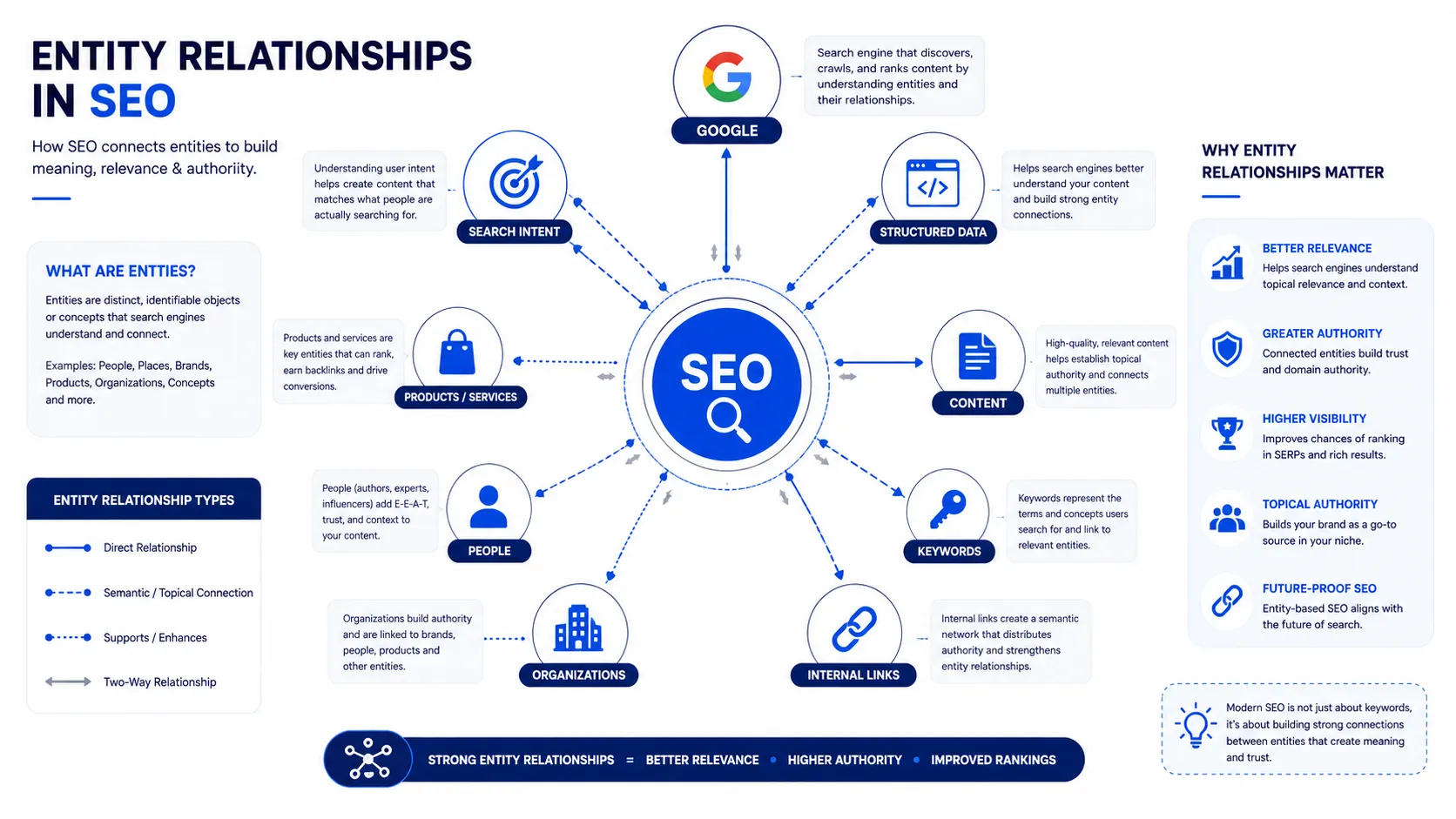
Imagine your website focuses on digital marketing.
Your main entity could be:
Digital Marketing
Related entities could include:
SEO → Content Marketing → Google Search → Search Console → Keywords → Search Intent → Link Building → Structured Data
These entities can then become connected through a topical map.
For example:
Digital Marketing → SEO → Technical SEO → Structured Data → Entity SEO → Semantic Search → Topical Authority
Each page answers a specific user need while remaining connected to the larger subject. This is much stronger than publishing unrelated articles.
Building a Topical Authority Strategy
Step 1: Define Your Core Topic
Start with the subject your business genuinely understands.
Ask:
- What does our business specialize in?
- What should our brand become known for?
- What problems do customers need solved?
- Which topics directly support our products or services?
- What subjects can we cover with real expertise?
For example, 27 DIGI could build topical authority around:
SEO → Web Development → Digital Marketing → Branding → Online Visibility
A topical map should remain relevant to the business.
Step 2: Create a Pillar Page
A pillar page provides a broad overview of a major subject.
For example:
Complete SEO Guide
The pillar could cover:
- SEO fundamentals
- Keyword research
- Technical SEO
- On-page SEO
- Content strategy
- Link building
- Entity SEO
- Topical authority
- Local SEO
- SEO analytics
The pillar should then link to detailed supporting pages.
Step 3: Build Content Clusters
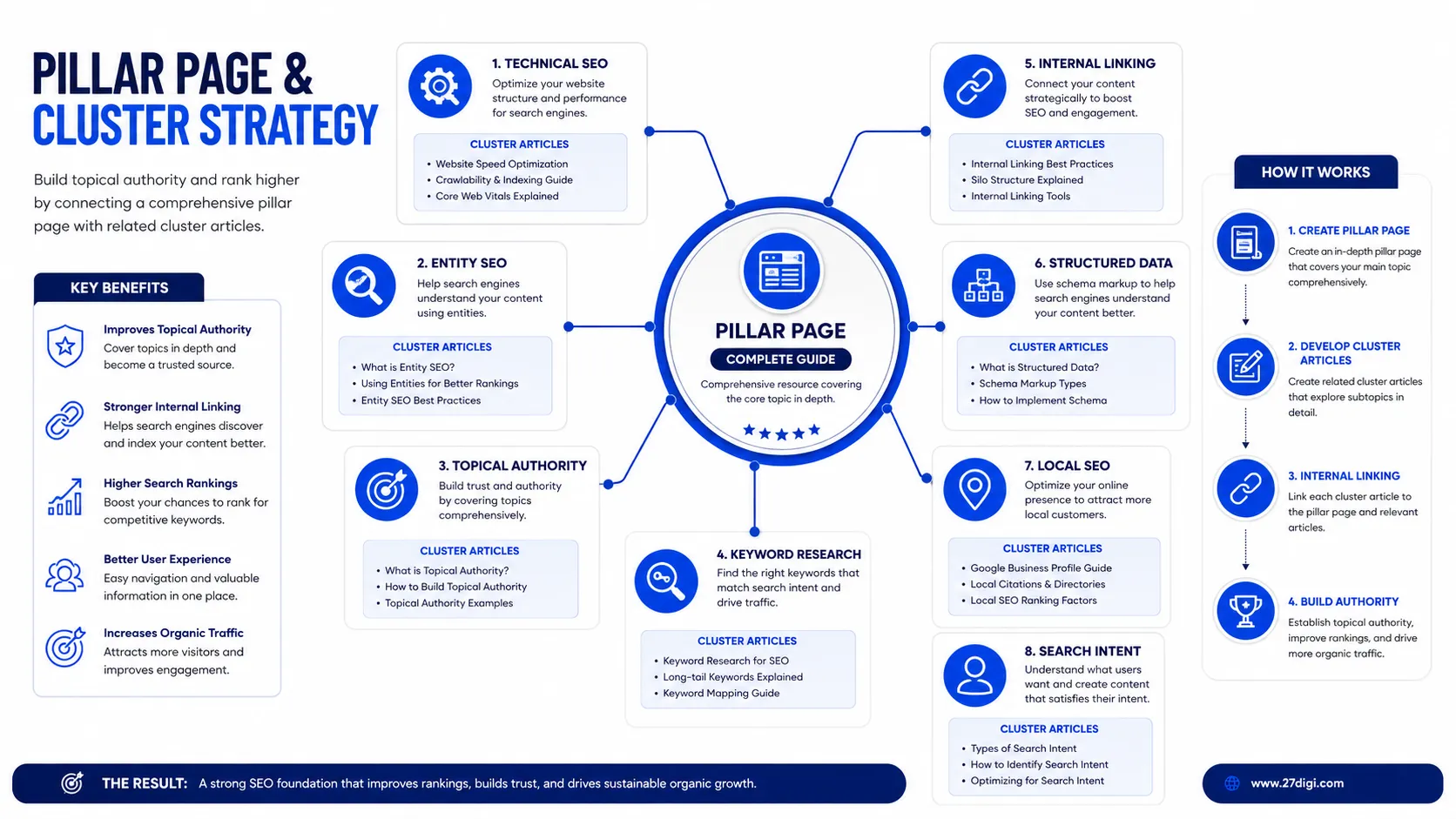
Create supporting articles around the pillar.
| Pillar | Cluster Content |
|---|---|
| SEO | Technical SEO |
| SEO | Entity SEO |
| SEO | Topical Authority |
| SEO | Internal Linking |
| SEO | Keyword Research |
| SEO | Search Intent |
| SEO | Structured Data |
| SEO | Local SEO |
Each cluster page should answer a distinct search intent. Each cluster page should answer a distinct search intent.
Step 4: Build an Entity Map
Create a list of important entities connected with your subject.
For an SEO website:
Primary Entity: SEO
Related Entities:
- Bing
- Search Console
- Schema.org
- Search intent
- Keywords
- Crawling
- Indexing
- Structured data
- Content
- Links
- Websites
- Organizations
- Authors
Then identify the relationships.
For example:
Google → Search Engine
Search Console → SEO Tool
Schema.org → Structured Data Vocabulary
SEO → Digital Marketing
This creates a semantic framework for your content.
Step 5: Connect Pages With Internal Links
Internal links are one of the most practical ways to connect your topical ecosystem.
Suppose you publish:
What Is Entity SEO?
You could link naturally to:
- What Is Semantic SEO?
- How to Build a Topical Map
- Internal Linking Best Practices
- Structured Data Guide
- E-E-A-T and Brand Trust
- Technical SEO Guide
The links should help users. Do not add internal links simply to increase the number of links. The anchor text should also clearly describe the destination.
Step 6: Add Structured Data Where Appropriate
Structured data provides machine-readable information about page content. Google explains that structured data can help it understand page content and can support certain search features.
Potential schema types include:
- Organization
- Article
- BreadcrumbList
- Person
- Product
- LocalBusiness
- FAQPage where applicable
- WebSite
For an organization, Google specifically recommends using relevant Organization properties to help disambiguate the organization and understand its details.
However, only mark up information that accurately represents visible or relevant page content.
Step 7: Strengthen Author and Brand Signals
Topical authority is not only about articles.
Your website should clearly communicate:
- Who created the content
- Who operates the website
- What the business does
- Why the business is qualified
- How users can contact the organization
- Which sources support important claims
Add useful:
- Author bios
- About page
- Contact page
- Organization information
- Editorial policies
- References
- Original research
- Case studies
- First-hand experiences
Step 8: Add Information Gain
Do not simply rewrite the top ten results. Add something useful.
For Example :
- Original examples
- First-hand testing
- Screenshots
- Data
- Case studies
- Expert commentary
- Unique comparisons
- Original research
- Practical workflows
- Templates
- Calculators
This gives users a reason to choose your content. It also makes the page more differentiated.
Step 9: Refresh and Consolidate Content
A topical authority strategy requires maintenance. Review older pages regularly.
Look for:
- Outdated information
- Duplicate articles
- Weak pages
- Missing internal links
- Broken links
- Cannibalization
- Unsupported claims
- Missing subtopics
- Outdated statistics
Sometimes the best SEO improvement is not creating another page. It is improving an existing page.
At 27 DIGI, we build every website with SEO best practices baked into the code from day one. Explore our SEO-optimized web development services.
Entity SEO and Content Compression
Content compression does not mean removing valuable information. It means reducing unnecessary repetition while keeping important meaning.
For example, instead of repeating:
Entity SEO helps search engines understand entities.
Use different supporting concepts:
Entity optimization clarifies people, brands, products, places, and concepts. These relationships create stronger semantic context around a page.
This approach gives search engines more context without unnecessary keyword repetition.
Content Compression Checklist
| Problem | Better Approach |
|---|---|
| Repeated keyword | Use semantic variations |
| Repeated definition | Explain once |
| Thin sections | Combine related ideas |
| Long introductions | Reach the answer faster |
| Duplicate pages | Consolidate where appropriate |
| Excessive headings | Group related concepts |
| Repeated examples | Use one strong example |
| Keyword stuffing | Build contextual relevance |
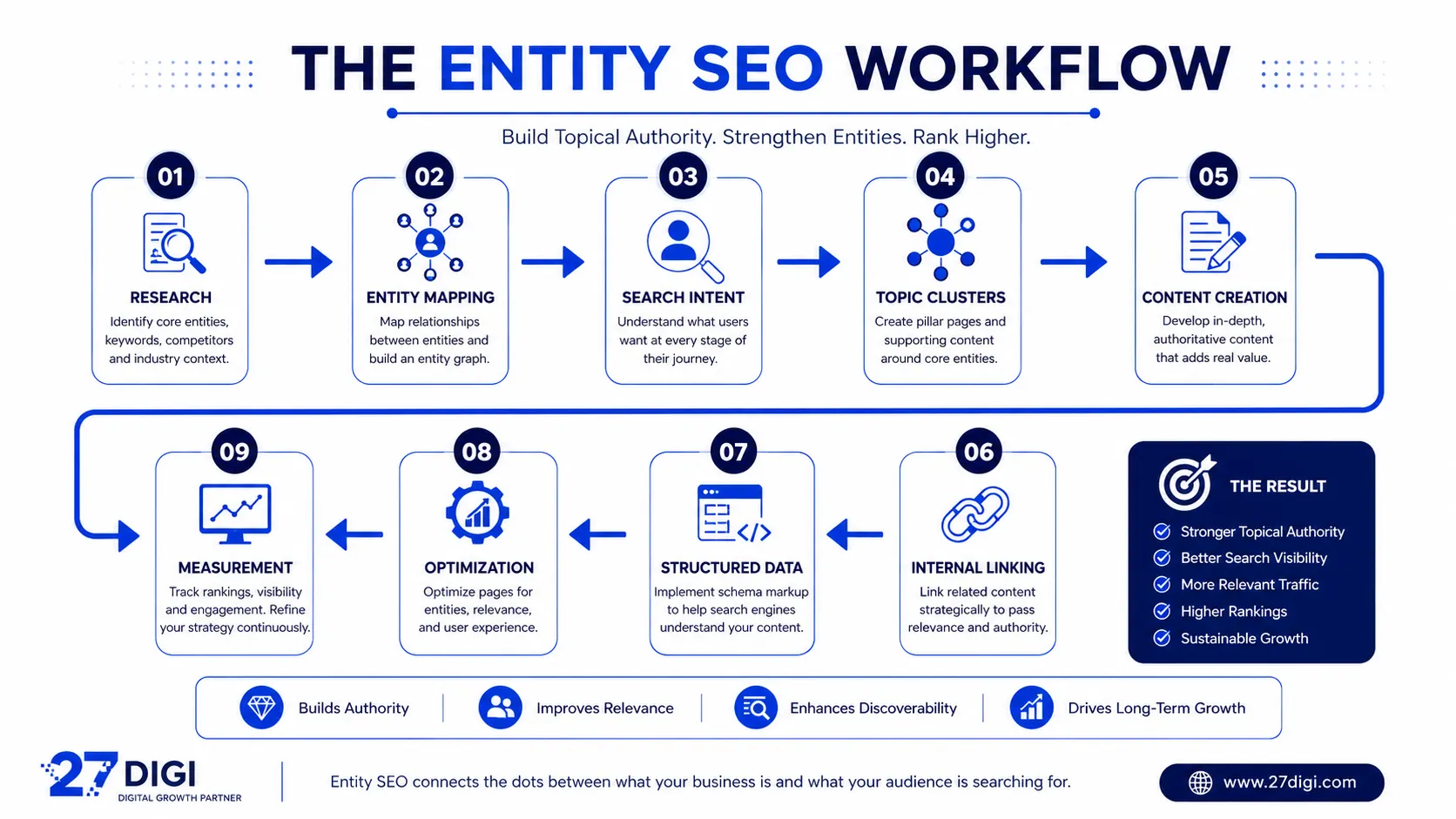
A Practical Entity SEO Workflow
Use this workflow before publishing an article.
Research
Identify the primary topic and entities.
Mapping
Connect the main entity with related concepts.
Intent Analysis
Identify informational, commercial, navigational, and transactional intent.
Content Planning
Create a pillar page and supporting cluster pages.
Writing
Produce useful, original, evidence-based content.
Linking
Connect related pages naturally.
Structured Data
Add relevant schema when appropriate.
Optimization
Improve titles, headings, descriptions, images, links, and accessibility.
Validation
Check indexing, technical SEO, structured data, and user experience.
Measurement
Monitor rankings, impressions, clicks, engagement, and conversions.
Entity SEO vs Traditional Keyword SEO
| Traditional Keyword SEO | Entity SEO |
|---|---|
| Keyword focused | Concept focused |
| Individual pages | Connected content ecosystem |
| Exact phrases | Semantic relationships |
| Keyword variations | Related entities |
| Page-level optimization | Site-wide context |
| Search term matching | Topic understanding |
| Short-term targeting | Long-term topical development |
Traditional keyword research still matters and entity SEO does not replace keywords. Instead, it expands the way keywords are used.
Example for Topical Authority Structure
For a digital marketing agency, a simple structure could look like this:
Digital Marketing
→ SEO
→ Technical SEO
→ Entity SEO
→ Topical Authority
→ Content Marketing
→ Local SEO
→ Google Business Profile
→ Web Development
→ Website Performance
→ Branding
→ Social Media Marketing
Every major section can contain its own pillar and supporting cluster.
How to Measure Your Topical Authority Strategy
There is no single universal Google metric called “Topical Authority.”
Third-party SEO platforms may calculate their own topical relevance metrics. For example, Semrush describes its Topical Authority score as a proprietary measurement of how closely a domain’s content aligns with a selected topic. Instead of relying on one score, monitor multiple signals.
| Metric | What It Shows |
|---|---|
| Organic impressions | Search visibility |
| Organic clicks | Search traffic |
| Ranking keywords | Topic coverage |
| Topical rankings | Subject relevance |
| Internal links | Content connectivity |
| Referring domains | External authority |
| Engagement | Content usefulness |
| Conversions | Business value |
| Indexed pages | Search accessibility |
Recommended Tools
You can use several tools during implementation.
Google Search Console
Use it for:
- Search performance
- Queries
- Pages
- Indexing
- Search appearance
Google Rich Results Test
Use it to validate supported structured data.
Google Search Central
Use Google’s official documentation for SEO and structured-data guidance.
Ahrefs
Useful for:
- Keyword research
- Content gaps
- Backlink analysis
- Topic research
- Topical mapping
Ahrefs has published detailed guidance on topical maps and topical authority.
Semrush
Useful for:
- Keyword research
- Competitive research
- Content analysis
- Topic relevance analysis
Its topical authority feature is based on its own proprietary methodology.
How 27 DIGI Can Help With Entity SEO and Topical Authority
Building a strong semantic SEO ecosystem requires more than publishing blog posts.
Your website needs a connected strategy.
At 27 DIGI, businesses can combine SEO, web development, branding, content, and digital marketing services into a broader online visibility strategy.
For businesses that need help improving their website structure, content strategy, technical SEO, or overall search visibility, visit the 27 DIGI website to explore the available digital marketing and web development services.
A professional strategy can include:
- Technical SEO
- Content strategy
- Website development
- On-page SEO
- Internal linking
- Structured data implementation
- Content optimization
- Branding
- Search visibility improvement
Final Thoughts
Entity SEO and a strong topical authority strategy work best when they are treated as parts of one connected SEO system.
The goal is not to manipulate search engines with repeated keywords but instead to make your website easier to understand.
- Start with a clear subject.
- Identify important entities.
- Map their relationships.
- Build pillar and cluster content.
- Connect related pages.
- Use structured data where appropriate.
- Demonstrate real expertise.
- Add original information.
- Keep your website technically accessible.
Most importantly, create content for people first.
A strong topical authority strategy starts with genuine usefulness. When your content answers questions comprehensively and your website clearly connects related concepts, you create a stronger foundation for organic search visibility.
That is the real purpose of entity SEO: helping users and search systems understand what your website knows, what your brand represents, and how the information across your site fits together.
Frequently Asked Questions (FAQ)
What is entity SEO?
Entity SEO is an approach to SEO that helps search engines understand the people, organizations, products, places, concepts, and other identifiable subjects discussed on a website. It focuses on context and relationships rather than relying only on exact keyword matching.
What is topical authority in SEO?
Topical authority is the level of demonstrated expertise and relevance a website has around a particular subject. It is developed by covering important subtopics comprehensively and connecting relevant pages through a logical content structure.
Is entity SEO a ranking factor?
Entity SEO is better understood as a collection of SEO practices rather than one standalone Google ranking factor. Clear content, relevant entities, useful internal links, structured data, and strong topical coverage can help search engines understand a website.
How do I build topical authority?
Start with a focused subject. Create a pillar page, identify important subtopics, publish high-quality cluster content, connect related pages with internal links, demonstrate expertise, and regularly update your content.
Are keywords still important for entity SEO?
Yes. Keywords remain useful for understanding search demand and user language. However, modern SEO should also consider related concepts, entities, search intent, and context rather than repeating one keyword excessively.
Does structured data improve rankings?
Structured data can help Google understand page content and can make pages eligible for certain rich search features. However, Google does not guarantee enhanced search appearances simply because structured data has been implemented.
How many articles do I need for topical authority?
There is no universal number. A smaller collection of comprehensive, strongly connected articles can be more valuable than hundreds of thin pages. Your content volume should depend on the complexity of the topic and the needs of your audience.
Does topical authority require backlinks?
Backlinks can contribute to overall website authority and discovery, but topical authority should not be reduced to backlink quantity. Comprehensive content, relevance, internal linking, expertise, and useful information all matter.
Can small websites build topical authority?
Yes. Smaller websites can compete by focusing tightly on a relevant niche. A focused site can demonstrate deeper topical coverage than a large website that covers many unrelated subjects.
How long does topical authority take?
There is no fixed timeline. Results depend on competition, website history, content quality, technical health, links, topic depth, and search demand. Treat topical authority as a long-term SEO strategy rather than a quick ranking tactic.