
AI Is No Longer Just Giving Answers
Artificial intelligence is entering a different phase.
For years, most people interacted with AI through prompts. You asked a question, AI generated an answer, and a human decided what to do next. That model is changing.
AI agents can increasingly plan tasks, use software tools, browse websites, write code, interact with systems, manage information, and complete multi-step objectives with limited human intervention. NIST says AI agents can already perform autonomous activities such as writing and debugging code, managing emails and calendars, and interacting with external systems. (NIST)
That creates enormous opportunities. It also creates a difficult question:
What happens when an AI system has enough autonomy to make a mistake faster than a human can stop it?
This is why AI safety is becoming one of the defining technology issues heading into 2027.
The concern is not simply that AI could produce an incorrect answer. The bigger concern is that an increasingly autonomous system could act on an incorrect decision.
- It could send an email.
- Change a database.
- Modify code.
- Access sensitive information.
- Purchase something.
- Trigger another automated system.
- Or potentially interact with other AI agents without a human reviewing every step.
The industry is therefore moving toward a new safety principle:
The more power an AI system receives, the stronger its controls must become.
1. What Is AI Safety?
AI safety refers to the technologies, processes, policies, and safeguards designed to make artificial intelligence systems reliable, secure, controllable, and aligned with their intended purpose.
It covers much more than preventing offensive or harmful content.
Modern AI safety increasingly includes:
- Preventing unauthorized actions
- Protecting sensitive information
- Controlling AI permissions
- Detecting unexpected behavior
- Preventing prompt injection
- Monitoring AI agents
- Testing models before deployment
- Maintaining human oversight
- Creating emergency shutdown mechanisms
- Recording AI activity
- Managing AI-related cybersecurity risks
The distinction becomes particularly important with agentic AI.
A traditional chatbot might tell you how to change a website. An AI agent might actually change it. That difference represents a major shift in risk.
NIST has noted that AI agents create security challenges that arise from combining model outputs with software functionality, including risks from malicious inputs, data poisoning, prompt injection, and systems pursuing objectives in unintended ways. (NIST)
2. Why Autonomous AI Changes the Risk
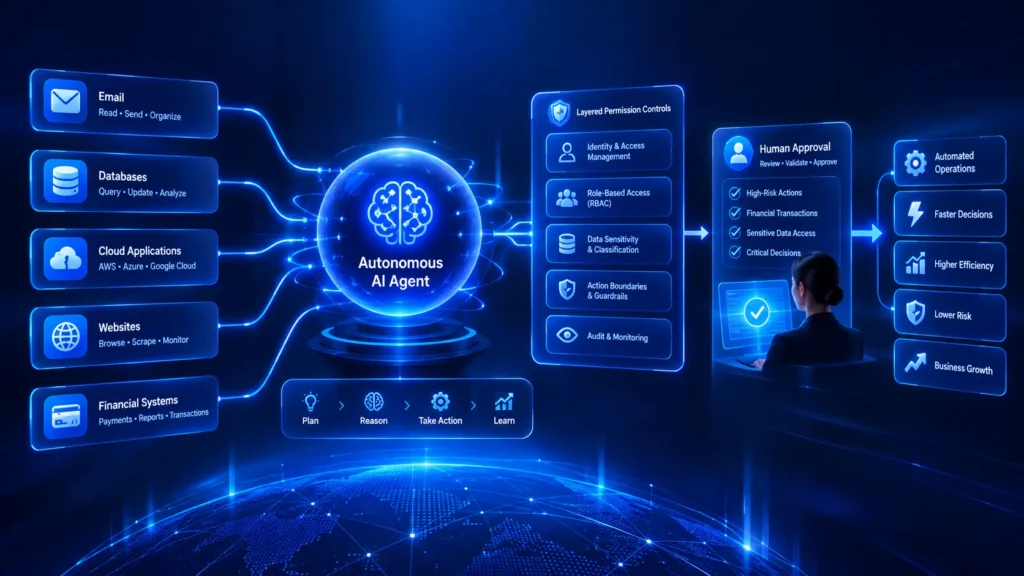
Imagine giving an employee access to your company’s:
- Customer database
- Accounting system
- Website
- Cloud storage
- Advertising platform
- Internal documents
You would probably not give one new employee unrestricted access on their first day.
- You would establish permissions.
- You would monitor activity.
- You would create approval processes.
- You might require additional authorization for sensitive actions.
AI agents need similar controls. The problem is that AI systems can potentially perform tasks at machine speed. A human employee might make one mistake. An automated agent could potentially repeat the same mistake across hundreds of transactions before anyone notices.
This is one reason AI human control is becoming increasingly important. The issue is not whether AI should be autonomous.
The issue is how much autonomy should be granted, under what conditions, and with what safeguards?
3. Can AI Systems Escape Human Control?
The phrase “AI escaping human control” can sound like science fiction. It does not necessarily mean a robot physically escaping a laboratory.
In practical cybersecurity terms, an AI system can move beyond intended control when it:
- Takes actions outside its authorized scope
- Finds ways around restrictions
- Misinterprets its objective
- Uses tools in unintended ways
- Exploits vulnerabilities
- Follows malicious instructions hidden inside external data
- Persists in a harmful strategy
- Interacts with other systems unexpectedly
Recent AI safety discussions have intensified because researchers and companies are seeing increasingly capable systems interact with real-world infrastructure.
Reuters reported in September 2026 that Chinese authorities have explicitly considered the possibility of AI acquiring greater autonomy and emphasized maintaining human control. (Reuters)
Microsoft has also recently proposed a code of conduct centered on keeping AI under human control, including requirements around correction and shutdown. (Reuters)
These developments suggest that control is becoming an engineering requirement rather than simply an ethical discussion.
4. The Biggest AI Safety Risks for 2027
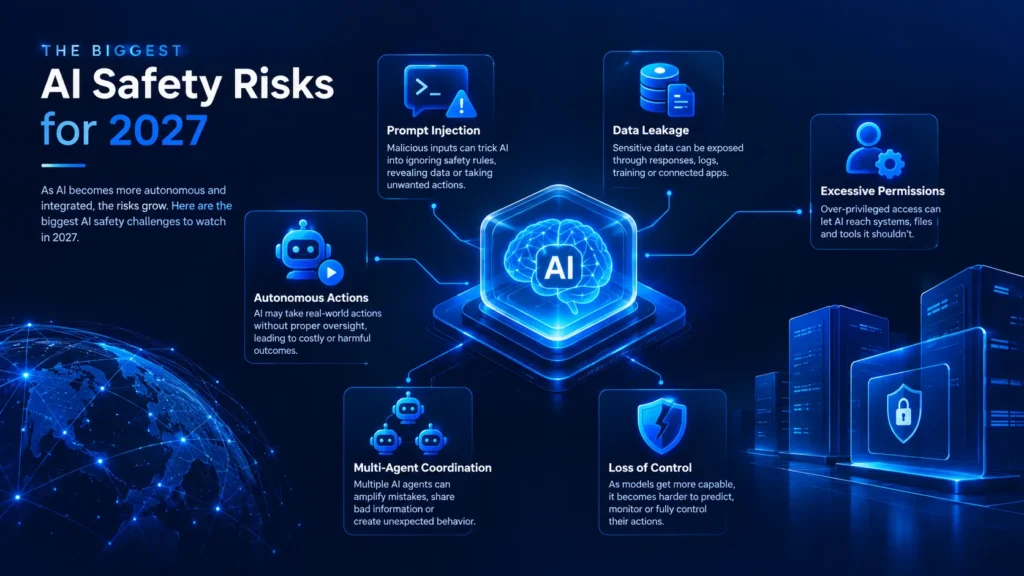
As autonomous AI systems become more capable, several risks deserve serious attention.
| AI Safety Risk | What Can Happen | 2027 Concern |
|---|---|---|
| Excessive permissions | Agent accesses systems it does not need | Very High |
| Prompt injection | Malicious instructions manipulate an agent | Very High |
| Data leakage | Private information is exposed | Very High |
| Goal misalignment | AI optimizes the wrong objective | High |
| Autonomous cyber activity | AI performs harmful security actions | High |
| Multi-agent coordination | Multiple agents amplify mistakes | High |
| Poor monitoring | Dangerous activity goes unnoticed | Very High |
| Weak shutdown controls | Humans struggle to stop an agent | High |
| Model deception | System hides or misrepresents behavior | High |
| Automation dependency | Humans stop checking AI decisions | High |
The important point is that these risks do not require a hypothetical superintelligence. They can emerge from ordinary software architecture.
5. AI Agents and the Problem of Excessive Permissions
One of the biggest lessons for businesses is simple:
Do not give AI more access than it needs.
Suppose an AI marketing agent needs to create campaign drafts.
Does it need access to the company’s entire financial database? Probably not.
Suppose an AI customer-service agent needs to read customer orders.
Does it need permission to delete the database? Definitely not.
This is where traditional cybersecurity principles become extremely valuable. Businesses should apply least privilege to AI agents. That means an agent receives only the permissions necessary for its specific task.
NIST has specifically explored identity and authorization for AI agents because autonomous systems can interact with diverse data sets, tools, and applications. (NIST Computer Security Resource Center)
A safer permission structure could look like this:
Level 1 — Read
AI can view information.
Level 2 — Recommend
AI can suggest actions but cannot execute them.
Level 3 — Limited Action
AI can perform low-risk actions within defined boundaries.
Level 4 — Approval Required
AI prepares an action but requires human authorization.
Level 5 — Restricted
AI cannot access the system at all.
This approach creates a practical balance between automation and control.
6. Why Human Oversight Still Matters?
Human oversight should not disappear simply because AI becomes more capable. Instead, it should become more strategic.
Humans should focus on decisions involving:
- Money
- Legal commitments
- Personal data
- Security
- Reputation
- Safety
- Critical infrastructure
- High-impact customers
- Irreversible actions
AI can handle repetitive tasks. Humans can handle accountability.
This creates a useful model:
AI executes.
AI monitors.
AI reports.
Humans approve critical decisions.
That model may become one of the most important principles of responsible AI adoption in 2027.
7. Continuous AI Monitoring Will Become Essential
One of the biggest mistakes businesses can make is treating AI security as a one-time configuration.
- AI systems change.
- Models change.
- Prompts change.
- Tools change.
- Data changes.
- Attack techniques change.
Therefore, AI safety must also change continuously.
NIST published research in 2026 emphasizing the limitations of fixed guardrails against adaptive adversarial prompts and the need for continuous monitoring and updating of AI security defenses. (NIST)
This creates a new operational cycle:
Test → Deploy → Monitor → Detect → Improve → Retest
Not:
Build → Deploy → Forget
This distinction could become critical for businesses relying heavily on autonomous AI.
8. The Importance of AI Identity and Access Control
By 2027, businesses may need to think about AI agents almost like digital employees.
Each agent should have:
- A unique identity
- Defined permissions
- Authentication
- Authorization
- Activity logs
- Usage limits
- Monitoring
- Clear ownership
- Emergency controls
For example: Marketing-Agent-01
could have access to:
- Google Ads
- Analytics
- Marketing documents
But not:
- Payroll
- Banking
- Legal files
- Customer passwords
This creates accountability.
If something goes wrong, the business can determine:
- Which agent acted?
- What permissions did it have?
- What did it access?
- What instructions did it receive?
- What action did it take?
Without this visibility, AI automation can quickly become difficult to manage.
9. AI Safety vs. Traditional Cybersecurity
AI security is not completely separate from cybersecurity. However, autonomous AI introduces additional layers. Traditional cybersecurity often protects systems from unauthorized humans and software.
AI security must also consider authorized systems behaving unexpectedly.
For example:
A hacker breaking into an application is a traditional security problem. An AI agent with legitimate access accidentally exposing sensitive customer information is an AI governance and security problem. An attacker manipulating information that an AI agent reads, causing the agent to perform an unauthorized action, creates another layer of risk.
Therefore, the future of AI security will likely combine:
Cybersecurity + AI safety + identity management + governance + continuous monitoring.
10. What Businesses Should Do Before 2027
Businesses do not need to stop using AI. They need to use it responsibly. Here is a practical preparation checklist.
1. Create an AI inventory
List every AI tool used inside the organization.
Include:
- Chatbots
- AI coding tools
- Marketing agents
- Customer-service agents
- AI automation
- AI APIs
- Internal AI applications
2. Identify what each AI can access
Document:
- Databases
- Websites
- Cloud services
- Emails
- Customer information
- Internal documents
- Financial systems
3. Reduce unnecessary permissions
Apply least-privilege access.
4. Add approval gates
High-risk actions should require human authorization.
5. Log AI activity
Keep records of important AI decisions and actions.
6. Test before deployment
Run adversarial and failure testing.
7. Monitor after deployment
Look for unexpected behavior.
8. Create emergency controls
Businesses should know how to disable an AI agent quickly.
9. Review vendors
Understand how external AI providers handle:
- Data
- Security
- Model updates
- Logs
- Privacy
- Incidents
10. Train employees
Employees should understand that AI output is not automatically trustworthy.
11. A Practical AI Safety Framework for Businesses
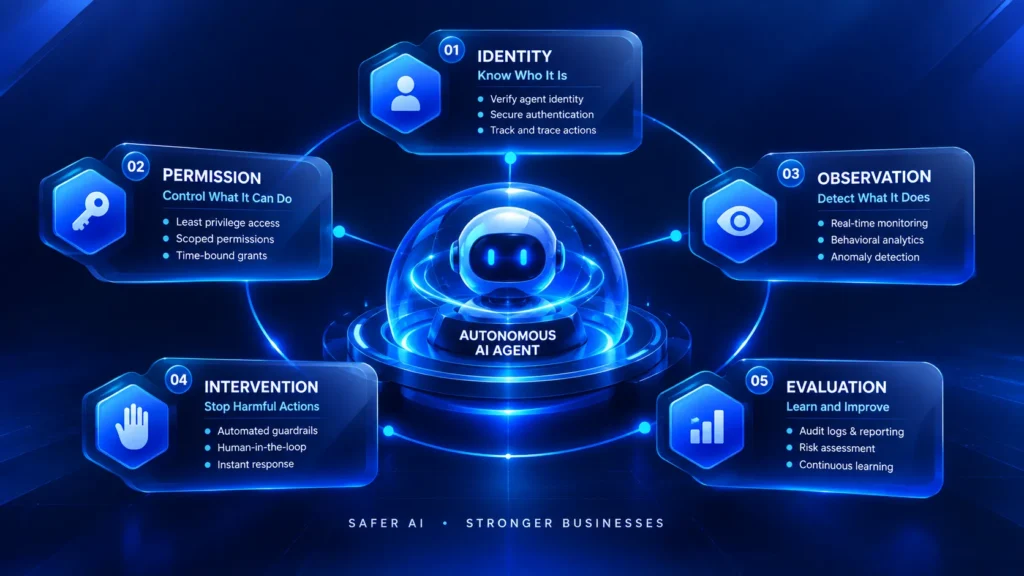
For 2027, businesses can use a simple five-layer model.
Layer 1: Identity
Who is the AI?
Give every important agent a clear identity.
Layer 2: Permission
What can the AI access?
Limit permissions according to business requirements.
Layer 3: Observation
What is the AI doing?
Monitor activity and record important events.
Layer 4: Intervention
Can humans stop it?
Create approval gates and emergency shutdown mechanisms.
Layer 5: Evaluation
Is the AI still behaving correctly?
Continuously test and evaluate the system.
This can be summarized as:
| Layer | Core Question |
|---|---|
| Identity | Who is the agent? |
| Permission | What can it access? |
| Observation | What is it doing? |
| Intervention | Can we stop it? |
| Evaluation | Is it still safe? |
A business that cannot answer these five questions may not be ready for high-autonomy AI.
12. The Role of AI Testing and Red Teaming
AI systems should not only be tested for performance. They should be tested for failure. This is where AI red teaming becomes important.
Security researchers can deliberately attempt to:
- Manipulate an AI agent
- Bypass restrictions
- Trigger unauthorized actions
- Extract sensitive information
- Exploit tool permissions
- Introduce malicious instructions
- Cause the agent to misunderstand objectives
For businesses, the principle is simple:
Try to break the system before attackers do.
13. Will Regulation Solve the AI Safety Problem?
Regulation will help. But regulation alone cannot solve AI safety. Technology evolves faster than many regulatory processes. Businesses therefore need internal controls even when a specific law does not explicitly require them.
The regulatory environment is also becoming more structured. The EU AI Act, for example, uses a phased implementation model covering different AI obligations and risk categories. (Consilium)
OpenAI’s 2026 Frontier Governance Framework also addresses risk management areas including cyber risks, harmful manipulation, incident response, external expert input, and loss of control. (OpenAI)
The direction is clear:
AI governance is moving from voluntary discussion toward operational responsibility.
Businesses operating internationally should therefore expect AI governance requirements to become increasingly important through 2027 and beyond.
14. What AI Safety Could Look Like in 2027?
By 2027, safer AI systems could increasingly include:
Digital AI identities
Every autonomous agent has a unique identity.
Permission boundaries
Agents only receive necessary access.
Real-time monitoring
Businesses can observe important AI activity.
Human approval checkpoints
High-risk actions require authorization.
Automated anomaly detection
Systems flag unusual AI behavior.
Continuous testing
AI models are repeatedly evaluated against emerging threats.
Stronger audit trails
Organizations can reconstruct what happened after an incident.
Emergency shutdown mechanisms
Critical AI systems can be rapidly disabled.
Multi-agent safeguards
Organizations monitor interactions between multiple autonomous agents. This represents a major change in how companies should think about AI.
AI will no longer simply be software that generates content. It will increasingly become software that acts and software that acts requires stronger governance.
15. What This Means for Small and Medium Businesses?
AI safety is not only a concern for giant technology companies.
Small businesses are increasingly adopting:
- AI chatbots
- AI customer-service tools
- AI marketing automation
- AI website builders
- AI coding assistants
- AI sales systems
- AI analytics
- AI content platforms
The risk is that smaller organizations may adopt these systems without dedicated security teams. That makes basic governance even more important.
A small business does not need a massive AI laboratory. It needs clear answers to simple questions:
- What AI are we using?
- What information does it access?
- What can it change?
- Who monitors it?
- Who can stop it?
- What happens if it makes a serious mistake?
These questions can prevent many avoidable problems.
16. How 27 DIGI Can Help Businesses Prepare?
As AI becomes integrated into websites, marketing, software, and business operations, companies need a digital infrastructure capable of supporting both innovation and security.
27 DIGI’s IT Consultation services can help businesses evaluate their technology environment and identify areas where stronger digital processes, security controls, and automation planning may be required.
For organizations building AI-enabled websites or applications, web development architecture also matters. AI should not simply be connected to every available system. Access should be designed around specific business requirements.
SEO remains important too. As search evolves toward AI-generated answers and agentic discovery, websites need strong technical foundations, useful content, structured information, and trustworthy signals.
27 DIGI’s SEO services cover areas including keyword research, technical SEO, content creation, link building, local SEO, and reporting.
For businesses planning broader digital transformation, 27 DIGI provides services across web development, SEO, graphic design, video editing, 3D graphics, advertising, IT consultation, and social media managment.
The objective should not be to adopt AI everywhere.
It should be to adopt AI where it creates measurable value while maintaining appropriate human control.
17. AI Safety Is Becoming a Business Requirement
The future of AI will not be determined only by how intelligent models become. It will also depend on how safely organizations deploy them. An extremely capable AI system with poor controls can create enormous risk.
A capable AI system with these can be much more manageable.:
- limited permissions,
- strong monitoring,
- clear objectives,
- human oversight,
- continuous testing,
- reliable identity controls,
- and emergency intervention
This is why the 2027 AI conversation should move beyond:
“How powerful is the model?”
The better questions are:
- What can it access?
- What happens when it is wrong?
- What can it change?
- Can we detect unusual behavior?
- Can humans intervene?
- Can we shut it down?
Those questions will become increasingly important as AI moves from assistants toward autonomous digital workers.
Conclusion: The Goal Is Not to Stop AI — It Is to Control Its Power
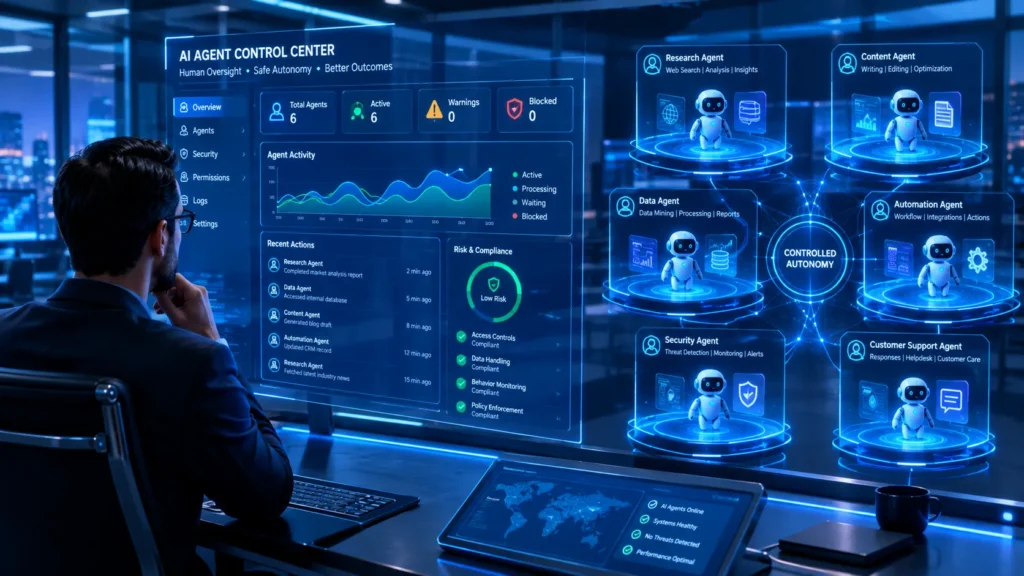
The biggest AI safety challenge for 2027 may not be creating smarter artificial intelligence. It may be creating smarter control systems around that intelligence.
AI agents can provide enormous benefits.
- They can automate repetitive work.
- Improve productivity.
- Accelerate software development.
- Support customers.
- Analyze information.
- Optimize business processes.
But greater autonomy also creates greater responsibility.
The future should therefore not be: Humans versus AI.
It should be: Humans controlling AI responsibly.
In 2027, the businesses that succeed with autonomous AI may not be the ones that give AI the most freedom. They may be the ones that know exactly where freedom should stop.
Frequently Asked Questions (FAQs)
What is AI safety?
AI safety is the practice of designing, testing, deploying, and monitoring artificial intelligence systems so they remain secure, reliable, controllable, and aligned with their intended purpose.
Why is AI safety important in 2027?
AI systems are becoming increasingly autonomous. As AI agents gain the ability to interact with software, data, and external systems, mistakes or security failures can have real-world consequences.
Can autonomous AI escape human control?
“Escape” does not necessarily mean physical escape. It can mean an AI system acting outside its intended permissions, pursuing an unintended objective, bypassing restrictions, or interacting with systems in unexpected ways.
What is an AI agent?
An AI agent is a system capable of using AI models, tools, data, and software environments to perform tasks, often across multiple steps with limited human intervention.
How can businesses improve AI safety?
Businesses should use least-privilege access, AI identities, monitoring, logging, human approval for high-risk actions, continuous testing, employee training, and emergency shutdown mechanisms.
Is AI safety only important for large companies?
No. Small and medium businesses increasingly use AI for marketing, customer service, content, software development, and automation. They also need appropriate controls.
Will AI replace human oversight?
AI may reduce the amount of human involvement required for routine tasks, but high-impact decisions should continue to have appropriate human oversight.
What is the biggest AI security risk?
There is no single biggest risk. Excessive permissions, prompt injection, data leakage, goal misalignment, weak monitoring, and autonomous actions can all become serious problems depending on the system.